
Document of the Month 7/26: An Old Uyghur Fragment of Manichaean Scripture from Xinjiang
03 August 2026
The Many Uses of Folio “III 198”: Book Culture and Lived Religion in Early Medieval Turfan
by Leighton Smith
Summary:
This Document of the Month examines the Manichaean manuscript fragment III 198 from Turfan (China), arguing that its significance extends beyond its canonical text and celebrated colophon. By focusing on three marginal inscriptions left by lay Manichaean readers, it reasons that this manuscript actively functioned in religious life as more than just a repository of doctrine.
Folio “III 198” as Artefact: Discovery and Importance
In the middle of November 1904, Albert von Le Coq (1860-1930) and Theodor Barthus (1858-1941) arrived at the ruins of a city known as Kočo (see Map) at the head of the second expedition sent from Berlin to modern-day Xinjiang.1 Arriving hot on the heels of the “First Turfan Expedition” (1902-1903) led by Albert Grünwedel (1856-1935), this Second Turfan Expedition (1904-1905) had big shoes to fill. The First Expedition had exploited a particular confluence of social and political factors produced by the Qing administration of Xinjiang and European imperialism more broadly, and its leaders – Albert Grünwedel, Georg Huth (1867-1906), and Theodor Barthus – had returned to Berlin with crates of manuscripts in then-unknown languages, murals chipped and chiselled from walls, and a motley mix of other materials and artefacts extracted from Turfan.2
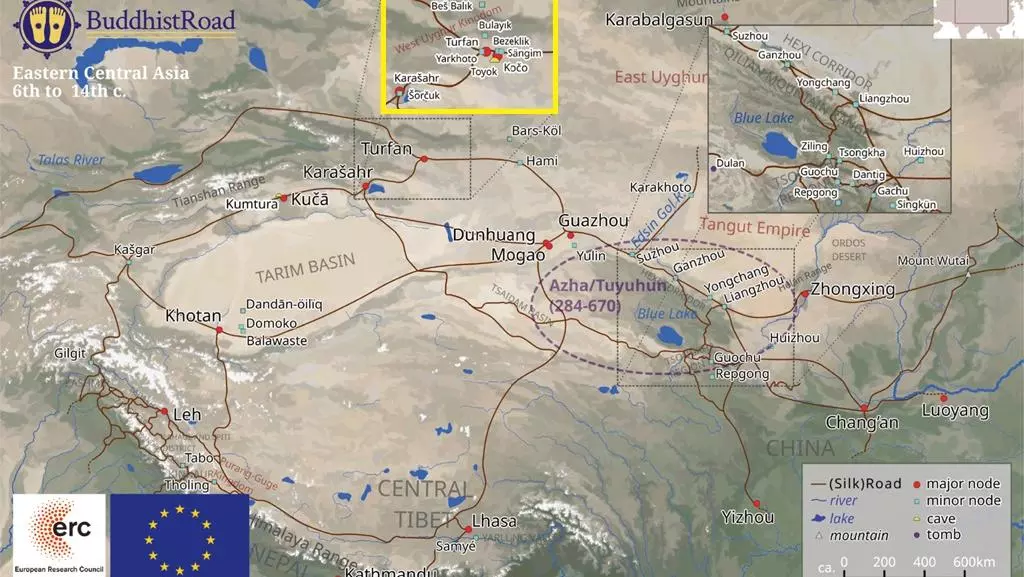
Fig. 1: © ERC BuddhistRoad, 2023. Eastern Central Asia 6th to 14th c. Published in "Buddhism in Central Asia III: Impacts of Non-Buddhist Influences, Doctrines", ed. by Lewis Doney, Carmen Meinert, Henrik H. Sørensen, and Yukiyo Kasai (Leiden: Brill, 2023), 260-261. The map was produced by Jürgen Schörflinger. Map modified with yellow square to highlight the location of Turfan
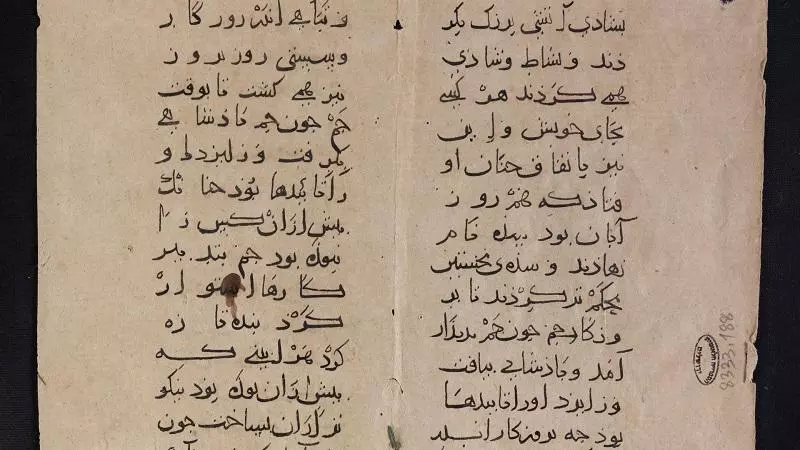
Luckily for von Le Coq, the situation on the ground had not changed substantially in the intervening year, and the Second Expedition doubled the spoils of the First. After many months in Turfan, the Second Turfan Expedition returned to Berlin with over a hundred more crates of objects from the ruins of Xinjiang.3 Among these artefacts shipped to modern-day Germany was a loose, polychrome folio (Figs. 2 & 3) then labelled “T[urfan] II D[akianus-shahr] 171” (now III 198) which was most likely written at the beginning of the 11th century CE.4 This folio, one of the more elaborate Manichaean fragments from Turfan, is the subject of this Document of the Month.
Despite their fragmentary state, III 198 and other loose folia from Turfan ended up having an enormous impact on religious studies in Europe. To the surprise of Albert von Le Coq, Albert Grünwedel, and their colleagues at the Berlin Museum für Völkerkunde (“Ethnological Museum”), III 198 and many other artefacts from these expeditions proved not to be from the well-known historical Buddhist communities of Turfan but from a more obscure efflorescence of Manichaeism.
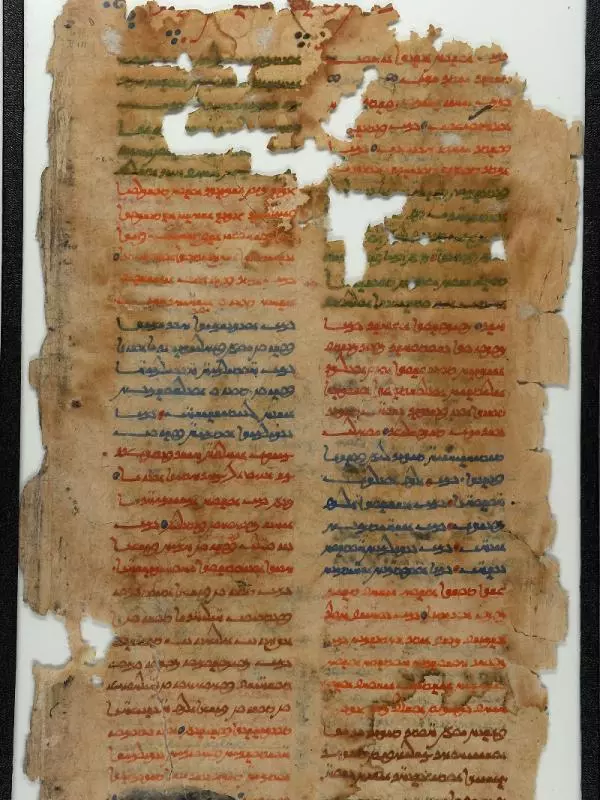
Fig. 3, Verso of III 198, containing a colophon executed across two columns in a multi-colored chequerboard pattern; © Museum für Asiatische Kunst, SMB-SPK/Photo: Jürgen Liepe
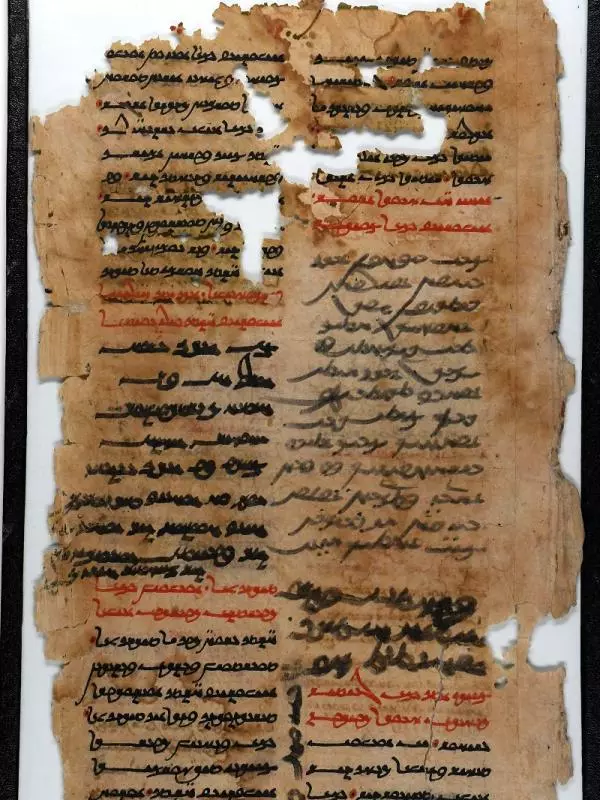
Fig. 2, Recto of III 198, containing Manichaean scriptural material in Old Uyghur along with three later records left between the columns by three lay reciters of the manuscript to which this folio belonged; © Museum für Asiatische Kunst, SMB-SPK/Photo: Jürgen Liepe
Folio “III 198” as Literary Fragment: An Example of Manichaean Writing
As a system of belief, Manichaeism was most fundamentally organised around a notion of the “two principles and the three times,” that is, the two opposed principles of light (good) and darkness (evil) and their primordial distinction, current mixture, and anticipated future separation.5 In turn, the standard Manichaean stance was that our world is a means to the end of rectifying a cosmogonic entanglement of light and darkness. To achieve this aim, the normative Manichaean community was split between the laity or “Hearers” who mingled with the world and a sacerdotal class or “Elect” who maintained the ascetic distance and ritual purity needed to liberate the light trapped in this world. In particular, the Hearers were to render a lightful portion of the food that they procured or produced to these Elect as alms so that the latter might send the light within these alms out of this world and into paradise by means of their perfected constitutions and the intercession of various divine entities.6
Although Manichaeism was once a world religion with adherents from North Africa to southern China, the disappearance of organised Manichaean religious life at the turn of the first millennium meant that its history and beliefs could only be gleaned from the careful study of works by curious outsiders or furious religious opponents. In other words, Manichaeism was for nearly a thousand years only remembered and studied through the filter of non-Manichaeans or militantly anti-Manichaean, ex-Manichaeans such as the Catholic bishop Augustine of Hippo (354-430 CE). Therefore, when III 198 was published in the first salvo of Old Uyghur Manichaean materials from the German Turfan Expeditions, it provided the first peek in nearly a millennium past the discourse of curious or furious outsiders on Manichaeism and into the writings of Manichaeans themselves.7
Along with its fellow Manichaean fragments from Turfan, III 198 also attested to an interesting slice of world history which extended from modern-day Iraq to the modern-day Xinjiang Uyghur Autonomous Region and up into the middle of modern-day Mongolia.
Manichaeism and its followers traced their beginnings to the alleged revelations received by one Mar Mani, an erstwhile participant in a then-flourishing Jesus discourse who presented himself as an “apostle of Jesus Christ (ܫܠܝܚܐ ܕܝܝܫܘܥ ܡܫܝܚܐ [šəlīḥā d-Išōʿ məšīḥā]).”8 Born in the early third century CE, Mani lived and established his initial religious community some 4,000 kilometers from Turfan in modern-day Iraq before his imprisonment and premature death.9
Despite this misfortune for the early Manichaean movement, Mani’s followers came to understand him as more than just another apostle of Jesus. To his abandoned followers, Mani was understood as the bearer of a final revelation and teaching which could rectify the errors of the other contemporary Afro-Eurasian religious movements.10 From these beginnings in the late antique Middle East, Manichaeism became a global minority religion over the course of the first millennium, counting followers from the northern shores of Africa to the southeastern shores of modern-day China.
Across these many regions, polities, and centuries, Manichaeism surprisingly enjoyed official, state support in two successive different Uyghur kingdoms or “Khaganates,” the Uyghur Khaganate in Mongolia (744-840 CE) and the Uyghur Khaganate in Turfan (855/856-1209 CE).11 In turn, the last and best-funded efflorescence of Manichaeism came at the tail end of the first millennium, thousands of kilometres from Mani’s birthplace in the city of Kočo.
The Content of Folio “III 198”: Religious and Political History
As a written artefact, III 198 is a product of this confluence of religious and political histories in Turfan. On its recto side, in a careful book-hand, a scribe copied what is most likely a canonical Manichaean text known as the “Living Gospel” or, as its colophon states, “the divine Gospel (täŋritäm ew[angelyōn])” (Fig. 2).12 It is a translation of that canonical work into a Turkic language called Old Uyghur. In other words, this canonical work was here rendered in the language which had become associated with the local elites of Turfan who patronised Manichaean institutions and Manichaean books like this one.13
On the verso side, a colophon executed in an expensive, multi-coloured chequerboard pattern informs the reader that this manuscript was “written with every sort of ornament (tükäl türlüg etigin bitilmiš boltı),” a testament to the funds and precious materials being diverted to Manichaean institutions (Fig. 3).14 Dubbed the “Argu colophon,” this name and fame was earned from its dedication as a gift to the Manichaean community in “Argu” in the Talas River Valley in modern-day Kyrgyzstan. It attests to the place of Kočo as the hub of a Manichaeism with wider ambitions.15
Wedged in the intra-columnar gaps on the recto, three individuals noted that they had recited this manuscript. Of these three, two recorded their names, introducing themselves as the lay Manichaeans Vapxua and Arslan Mängü.16 I will concentrate the rest of my analysis on these notes and what they reveal about the role that manuscripts played in early medieval Central Asian religious life.
Folio III 198 as a Book Fragment
All three individuals note that they took the time to recite the manuscript to which folio III 198 once belonged. As our anonymous reciter wrote in a cramped, quick hand,
“baštın bärü adakka tägi okıtım suy yazok bolmaz[un]
I’ve recited [this book] from head to toe. May there be no transgression[s]!”17
Similarly, both Arslan Mängü and Vapxua are careful to note that they recited the manuscript after they introduce themselves and before they commenced with their requests and wishes:
“men vapxua eki yaruk orduka kertgün<č>lüg nugušak kıtaytın kälmištä bo ämig eki kata okıyu tägintim ··· kim mäntä ken okısar meni atayu yarlıgkazunlar bo beš agır bitmiš üčün yazokta käčir men manāstār <xirzā>
I, Vapxua, a Hearer with a belief in the two light palaces [i.e., the Sun and the Moon], respectfully recited this remedy twice over after I came in from Kıtay. Might those who read this after me please mention me [by name]. Since these five venerations have been completed (?), I am moving on from transgression. Release my sins (< Parthian manāstār hirzā)”18
“män eki yaruk orduka bäk katıg kertgünčlüg nugušak arslan mäŋü bo eki yıltız nomug okıyu tägintim kayu kutluglar okıs[ar]lar buyanta unıtmazunlar manāstār xirzā
I, Arslan Mängü, a Hearer with a firm belief in the two light palaces, have respectfully recited [this] book of the two principles. May any of the glorious ones who happen to recite [this book] not forget [me] during the merit transfer. Release my sins (< Pth. manāstār hirzā)”19
Arslan Mängü and Vapxua took up the majority of the blank space to insert details on who they were and their motivations for reciting the manuscript, leaving only three lines for the third annotator.
The two named reciters use similar language and state that they are lay Manichaeans or nugušak (“Hearer”) with a characteristically Manichaean belief in the “two light palaces (eki yaruk ordu),” that is, the Sun and Moon considered as divine components of Manichaean cosmology.20 Vapxua adds that they recited this “remedy (ämig) twice (eki kata)” after they had come to Kočo from “Kıtay,” meaning the regions to the northeast of Turfan (“kıtaytın kälmištä”).21
More subtly, both Arslan Mängü and Vapxua use the deferential and respectful modal tägin- to qualify their recitation, indexing their sense that this manuscript was sacred. Although their writings might look like irreverent graffiti to us, both Arslan Mängü and Vapxua clearly understood themselves to be acting as proper Manichaeans both in reciting this manuscript and in leaving behind a record of their recitation.
The anonymous reciter added in the column margin a request for absolution from his transgressions (suy yazok bolmazun). Arslan Mängü and Vapxua also ask to be freed from the consequences of their infractions but use an explicitly Manichaean formula drawn from the Manichaean confessional: the Parthian formula manāstār hirzā (“release my sin[s]”). Thus, reciting a manuscript like III 198 was understood as a means for a lay Manichaean to expunge the transgressions that they may have committed.22
Vapxua and Arslan Mängü also appear to expect that their writings will be read by individuals who they explicitly identify as “the glorious ones [kutluglar]” (i.e., the Manichaean clergy or “Elect”). Both make the same request to potential future readers: to have their names uttered during rituals that produce the “merit” (buyan) that dictates the quality of their afterlife.23 In reciting and handling the sort of book used in Manichaean ritual, Vapxua and Arslan Mängü sought to insert themselves in the sacred and religiously beneficial activities of the Manichaean clergy.
Conclusion: III 198 as a Testament to the Polyvalence of Religious Life
Beyond the confines of Manichaean Studies, III 198 illustrates the value of religious manuscripts as witnesses to the multiple voices, practices, and experiences that constituted a lived religion.24 By preserving a canonical text, a dedicatory colophon, and the records of individual readers side by side, the folio exemplifies the variety of uses to which manuscripts were put.
Notes
- The classic English language account of this and the other expeditions remains Boyce 1960, IX-XXIII. For a more recent and accessible English language account of these expeditions, see Sundermann 2004. For a longer and more lavishly illustrated German survey of these expeditions, see Dreyer 2015.
- On the political and social circumstances within which these and other expeditions to the region operated, see Jacobs 2020. Additionally, while local ways of using and interacting with these sites and the artefacts therein were occasionally the object of ire for our two Alberts, it should be noted that local familiarity with the archipelago of local ruins was a sine qua non for the “discoveries” of these and other foreign expeditions.
- Sundermann 2004.
- Dakianus-shahr is just one of the earlier names used for the ruins which contemporary scholarship (mostly) calls Kočo after the Old Uyghur name for that former city in the Early Medieval Period. However, that city has also historically born many names, and naming conventions vary across the different fields which discuss this site. Most prominently, fields closer to Sinology will tend to prefer the Chinese name for the site, namely Gaochang (高昌). Lastly, the dating of this folio and its textual content is not without controversy. Here, I have chosen to follow Larry Clark’s argument for dating at least the colophon of this manuscript to the “early 11th century” CE based on the rulers that it mentions (Clark 2017, 71). Even if only due to the historical decline of Manichaeism in the 11th century, it is then reasonable to assume that the rest of the material written on this folio can also be dated to around the same period of time as the colophon. However, it should be noted that other scholars have argued for a substantially later dating of the records of recitation discussed below based on their diction, morphology, and/or phonology. For a sample of the arguments for a later dating of these records, see Doerfer 1993, 198; Röhrborn 2011, 166; and Özertural 2008a, 64.
- For an overview of Manichaeism, see Sundermann 2009.
- For a discussion of the relationship of the Manichaean Elect, the Manichaean sacred meal, and the separation of these two principles, see BeDuhn 2000.
- III 198 was published in the first installment in the article series straightforwardly called “Turkish Manichaean Materials” (“Türkische Manichaica”) by von Le Coq in 1911 (von Le Coq 1911) and almost immediately re-edited (in part) by Wilhelm Radloff as part of the sixth installment of his article series called “Old Turkish Studies” (“Alttürkische Studien”) (Radloff 1912). After a long hiatus, III 198 and many other Manichaean texts published by von Le Coq were then reworked and republished by Zekine Özertural in 2008, and the manuscript has received its most recent treatment in Larry Clark’s sadly unfinished three-part series for the Corpus Fontium Manichaeorum: Series Turcica (Özertural 2008a; Clark 2017).
- This phrase is drawn from the famous “Mani Seal” now housed in the Bibliothèque nationale de France and has been published in Gulácsi 2010. On the relationship between Mani and Jesus in the earliest centuries of Manichaeism, see Pedersen 2023. For recent, critical work on the Mani biography, see Gardner 2019.
The Mani Seal exhibits a rare spelling of ܝܫܘܥ (“Jesus”) with two initial yods. While this spelling is also standard in Manichaean Middle Persian and Manichaean Parthian works which borrow the name from Manichaean Syriac, such a spelling is resolutely uncommon in non-Manichaean Syriac. To this point, the corpus of the Syriac Thesaurus Simtho (v. 1.0, February 2025) contains only two instances of ܝܝܫܘܥ as against the over seventeen thousand instances of the spelling ܝܫܘܥ. In turn, the double yod spelling might be a scribal convention specific to the Manichaean script. - For a survey of our preserved accounts of Mani’s death, see Gardner 2019, 59-82.
- For an overview of Manichaean understandings of other religions and the novel features of this approach to religions, see BeDuhn 2019.
- These Khaganates go and have gone by various names, and the names used here have merely been chosen for geographic clarity.
- III/198/V/i/9. For this and all other readings of the Old Uyghur, see Clark 2017, 67-70. Larry Clark’s most recent reconstruction of the colophon allows him to make a rather convincing case that the text here is from a canonical Manichaean work known as the “Living Gospel” (ibid., 67; 71; 73). Nevertheless, scholarship before him has either identified this text as belonging to a different canonical work based on a later addition to this folio or remained agnostic on the matter. In the former case, the text was initially taken to be the “Sūtra of the Two Principles” or 二宗經 (Èr zōng jīng) then later the Šābuhragān. For the initial identification of this manuscript with this “Sūtra of the Two Principles,” see Chavannes & Pelliot 1913, 142. For the permutation of this identification into the Šābuhragān argument, see Haloun & Henning 1953, 210n10. As no canonical Manichaean work is completely preserved, however, a touch of caution is due in identifying this fragment. For a discussion of scholarly uncertainty as to the identity of this manuscript, see Özertural 2008a, 62-63.
- For a survey of Manichaean literature in Old Uyghur, see Clark 1997.
- III/198/V/i/6-7. For studies of the pigments used in manuscripts from this region, see Durkin-Meisterernst et al. 2016 and Nöller & Hahn 2015.
- Here, I have followed Clark again in understanding this manuscript as written in Kočo but intended for a never realized delivery to Argu (Clark 2017, 73). The earlier position, however, was that this manuscript was written in Argu before being deposited at a later date in Kočo.
- On the now standard reading of these as three separate writings by three separate individuals, see Özertural 2008a, 64. For the preceding hundred years, our nameless reciter had endured the double indignity of being forgotten in addition to being anonymous!
- III/198/Recto/i/Addition 2/1-4. Here and elsewhere in this piece, the translations deviate slightly from the official, published translations by Larry Clark simply to better accompany this article, except where noted (Clark 2017). Lastly, I have not made any modifications to the transcription system used by Clark.
- III/198/Recto/i/Addition 1/1-13. The only substantial change of note here is that I have read agır as meaning something closer to veneration over Larry Clark’s obligations. For examples of agır with this meaning, see the digitized Uyghur Dictionary (Uigurisches Wörterbuch) hosted by the Lower Saxon Research Academy in Göttingen (Niedersächsische Akademie der Wissenschaften zu Göttingen) (http://woerterbuchnetz.de/UWB/). See as well the entry for the related verb agırla- (“to honor, to venerate”).
Larry Clark’s decision to transcribe the first-person singular pronoun as men in Vapxua’s writing but män in Arslan Mängü’s writing reflects a distinction in how these two writers spelled this pronoun. Namely, Vapxua spelled the word 'myn', while Arslan Mängü's text reads 'mn'. - III/198/Recto/ii/Addition 3/1-13.
- Put briefly, the Sun and Moon were understood by Manichaeans to be instrumental to the processes necessary both for individual salvation and the eschatological fixing of the world. In other words, professing belief in “the two light palaces (eki yaruk ordu)” functions here as a rather succinct synecdoche for professing belief in the entire system of Manichaean religious teaching.
- Rather substantial ink has been spilled on where exactly is meant here by “Kıtay” and what it implies for when Vapxua might have written this note. Although this term will become the general term for China in some languages (e.g., Uzbek Xitoy), Zekine Özertüral is correct to note that the Kıtay here is most likely the realm of the Khitai (Özertüral 2008, 64). Pace Özertüral, however, the realm of the Khitai in question is most likely the earlier Liao Dynasty (916-1125 CE) not the subsequent Western Liao or “Kara Khitai” as first argued by Édouard Chavannes and Paul Pelliot (Chavannes & Pelliot 1913, 141n1). For a fascinating piece on the various names for China (and an argument for taking Kıtay here to refer to China), see Lieu 2024.
Lastly, on the notion of book as “remedy” or medicine in Manichaeism, see Piras 2017. - Of note here is that the structure of Manichaean religious life would have necessitated some level of transgression on the part of the lay Manichaean as the ritual purity of the sacerdotal class or “Elect” and their abstention from polluting practices such as farming predicated on the messier lives of the laity or “Hearers.” For an extensive discussion of the body of the Elect, its ritual purity, and this particular form of religious bicameralism, see BeDuhn 2000.
- The term buyan here is an “Old Uyghur-ified” borrowing through Sogdian pwnyʼn of the Sanskrit term puṇya, a technical term which is usually rendered in English as “merit” (Wilkens 2021, 207b). Although this term assumedly entered Old Uyghur through Buddhist materials, the term buyan was also employed by Manichaeans, and its usage does not necessarily indicate much as to Arslan Mäŋü’s religious affiliation(s)! For a concise discussion of the concept of puṇya or “merit,” see Buswell Jr. & Lopez Jr., 2014, 681b. On these records as an example of Manichaean “merit transfer,” see Özertural 2008b.
- On the place of manuscripts in the study of “lived religion” in the historical field, see Coogan 2022. On the notion of “productive friction” or slight differences which enable instead of derail joint ventures and projects, see Tsing 2005.
BeDuhn, Jason. 2000. The Manichaean Body: In Discipline and Ritual. The Johns Hopkins University Press.
BeDuhn, Jason. 2015. “Mani and the Crystallization of the Concept of ‘Religion’ in Third Century Iran.” In Mani at the Court of the Persian Kings: Studies on the Chester Beatty Kephalaia Codex. Nag Hammadi and Manichean Studies 87. Brill.
Boyce, Mary. 1960. A Catalogue of the Iranian Manuscripts in Manichaean Script in the German Turfan Collection. Akademie-Verlag.
Buswell Jr., Robert, and Donald Lopez Jr. 2014. The Princeton Dictionary of Buddhism. Princeton University Press.
Chavannes, Édouard, and Paul Pelliot. 1913. “Un Traité Manichéen Retrouvé En Chine: Traduit et Annoté (Deuxième Partie).” Journal Asiatique 11 (1): 99–394.
Clark, Larry. 1997. “The Turkic Manichaean Literature.” In Emerging from Darkness: Studies in the Recovery of Manichaean Sources. Nag Hammadi and Manichaean Studies 43. Brill.
Clark, Larry. 2017. Uygur Manichaean Texts, Vol. III: Ecclesiastical Texts. Corpus Fontium Manichaeorum: Series Turcica, III. Brepols.
Coogan, Jeremiah. 2022. “Misusing Books: Material Texts and Lived Religion in the Roman Mediterranean.” Religion in the Roman Empire (RRE) 8 (3): 301–16.
Doerfer, Gerhard. 1993. Versuch Einer Linguistischen Datierung Älterer Osttürkischer Texte. Turcologica 14. Harrassowitz Verlag.
Doney, Lewis, Carmen Meinert, Henrik Sørensen, and Yukiyo Kasai, eds. 2023. Buddhism in Central Asia III: Impacts of Non-Buddhist Influences, Doctrines. Dynamics in the History of Religion 14. Brill.
Dreyer, Caren. 2015. Abenteuer Seidenstrasse: Die Berliner Turfan-Expeditionen, 1902-1914. E.A. Seemann Verlag.
Durkin-Meisterernst, Durkin, Michael Friedrich, Oliver Hahn, Agnieszka Helman-Wazny, Renate Nöller, and Simone-Christiane Raschmann. 2016. “Scientific Methods of Philological Scholarship: Pigment and Paper Analyses in the Field of Manuscriptology.” Journal of Cultural Heritage 17: 7–13.
Gardner, Iain. 2019. The Founder of Manichaeism: Rethinking the Life of Mani. Cambridge University Press.
Gulácsi, Zsuzsanna. 2010. “The Prophet’s Seal: A Contextualized Look at the Crystal Sealstone of Mani (216-276 CE) in the Bibliothèque Nationale de France.” Bulletin of the Asia Institute 24: 161–85.
Haloun, Gustav, and Walter Henning. 1953. “The Compendium of the Doctrines and Styles of the Teaching of Mani, The Buddha of Light.” Asia Major 3 (2): 184–212.
Jacobs, Justin. 2020. The Compensations of Plunder: How China Lost Its Treasures. The University of Chicago Press.
Meinert, Carmen. 2024. “People, Places, Texts, and Topics: Another Look at the Larger Context of the Spread of Chan Buddhism in Eastern Central Asia during the Tibetan Imperial and Post-Imperial Period (7th–10th C.).” In Buddhism in Central Asia III: Impacts of Non-Buddhist Influences, Doctrines. Brill.
Nöller, Renate, and Oliver Hahn. 2015. “Illuminated Manuscripts from Turfan Tracing Silk Road Glamour by Analyzing Pigments.” STAR: Science & Technology of Archaeological Research 1 (2): 50–59.
Özertural, Zekine. 2008a. Der Uigurische Manichäismus. Neubearbeitung von Texten Aus Manichaica I Und III von Albert v. Le Coq. Veröffentlichungen Der Societas Uralo-Altaica 74. Harrassowitz in Kommission.
Özertural, Zekine. 2008b. “Puṇya Und Puṇya-Übertragung Im Uigurischen Manichäismus.” Zentralasiatische Studien Des Seminars Für Sprach- Und Kulturwissenschaft Zentralasiens Der Universität Bonn 37: 111–18.
Pedersen, Nils Arne. 2023. “Differing Interpretation of Mani’s Apostolate in Manichaean Sources: Subordination or Superiority?” In Manichaica Taurinensia. Corpus Fontium Manichaeorum: Analecta Manichaica, II. Brepols.
Piras, Andrea. 2017. “The Writing Hearer. A Suggested Restoration of M 101d.” In Zur Lichten Heimat. Studien Zu Manichäismus, Iranistik Und Zentralasienkunde Im Gedenken an Werner Sundermann. Iranica 25. Harrassowitz Verlag.
Radloff, Wilhelm. 1912. “Alttürkische Studien VI.” Bulletin de l’Académie Impériale Des Sciences de St. Pétersbourg (Извѣетія Императорской Академіи Наукъ. 6 (12): 747–78.
Röhrborn, Klaus. 2011. “Zum Schrifttum Der Westtürkischen Manichäer.” In Der Östliche Manichäismus: Gattungs- Und Werkgeschichte. Vorträge Des Göttinger Symposiums Vom 4./5. März, edited by Zekine Özertural and Jens Wilkens. Abhandlungen der Akadamie der Wissenschaften zu Göttingen.
Sundermann, Werner. 2004. “Turfan Expeditions.” In Encyclopaedia Iranica. https://doi.org/10.1163/2330-4804_EIRO_COM_1250.
Sundermann, Werner. 2009. “Manicheism i. General Survey.” In Encyclopaedia Iranica. https://www.iranicaonline.org/articles/manicheism-parent/manicheism-1-general-survey/.
Tsing, Anna. 2005. Friction: An Ethnography of Global Connection. Princeton University Press.
Uigurisches Wörterbuch, digitalisierte Fassung im Wörterbuchnetz des Trier Center for Digital Humanities, Version 01/25, <https://www.woerterbuchnetz.de/UWB>, abgerufen am 14.06.2026.
Le Coq, Albert von. 1911. “Türkische Manichaica Aus Chotscho I.” In Abhandlungen Der Königlich Preussischen Akademie Der Wissenschaften. Verlag der königlichen Akademie der Wissenschaften.
Wilkens, Jens. 2021. Handwörterbuch Des Altuigurischen (Altuigurisch - Deutsch - Türkisch). Universitätsverlag Göttingen.
Cite this article
Smith, L. 2026. "The Many Uses of Folio “III 198”: Book Culture and Lived Religion in Early Medieval Turfan" Eds. M. Arghandehpour, E. Shawe-Taylor and A. Azad. Document of the Month. Invisible East. doi: https://dx.doi.org/10.5287/ora-nr8wvpqn8
About the author
Leighton Smith is a graduate student in the History Department at the University of California, Irvine. He researches the former world religion of Manichaeism and is currently completing a dissertation on Manichaean book culture(s) and the place of literate labor in the history of Manichaeism in Early Medieval Turfan.
The online series, Document of the Month, presents some of the most interesting and revealing medieval documents from the desks of Invisible East researchers and their colleagues worldwide. Each piece in the series is dedicated to a single document or a closely related group of documents from the Islamicate East and tells their story in an engaging and accessible way. You will also find images, editions and translations of the documents. If you would like to contribute to the Document of the Month series, please, get in touch with the team.