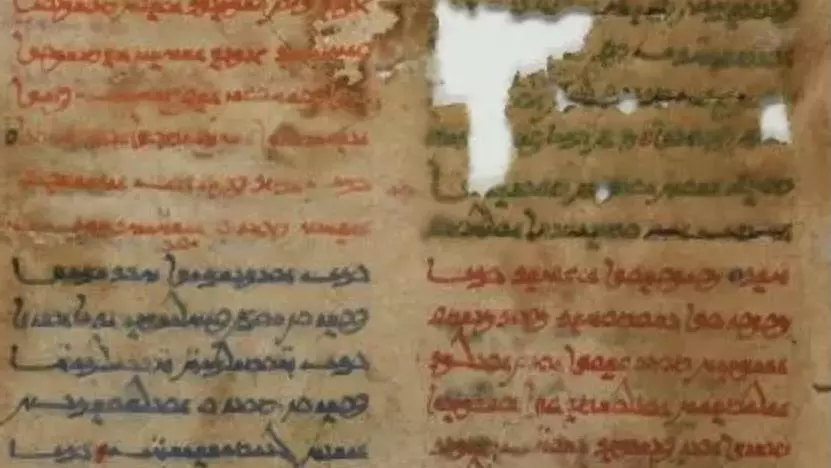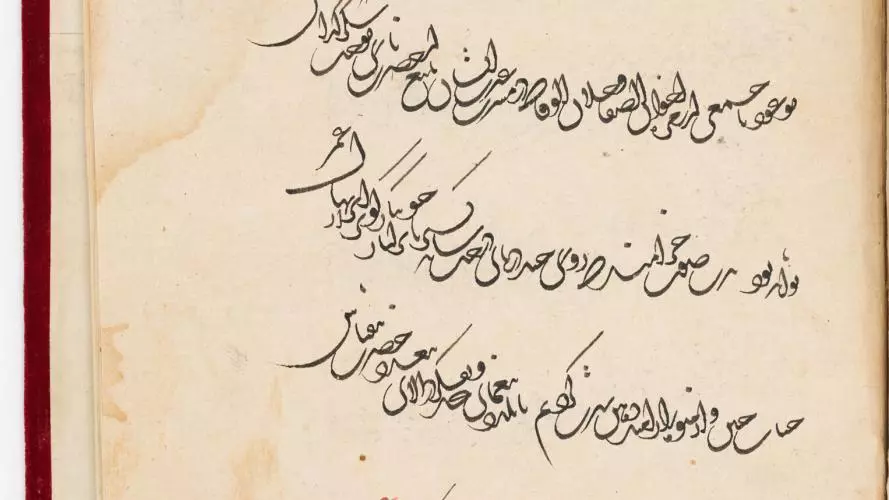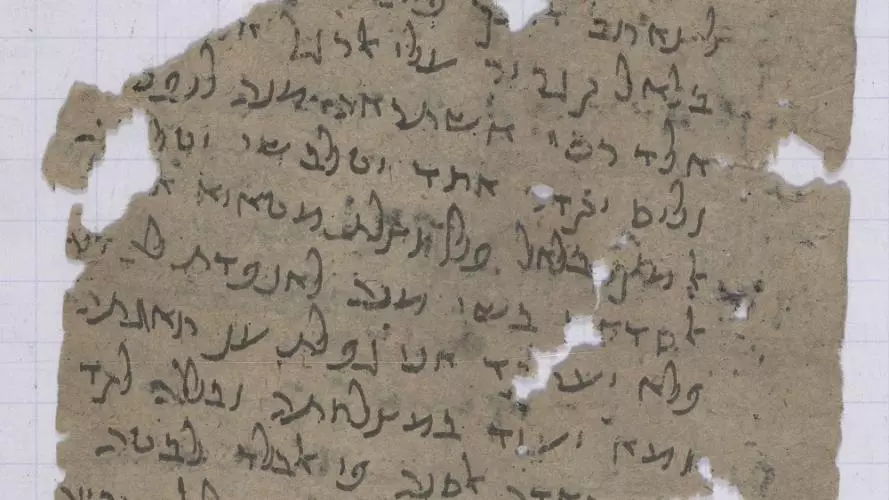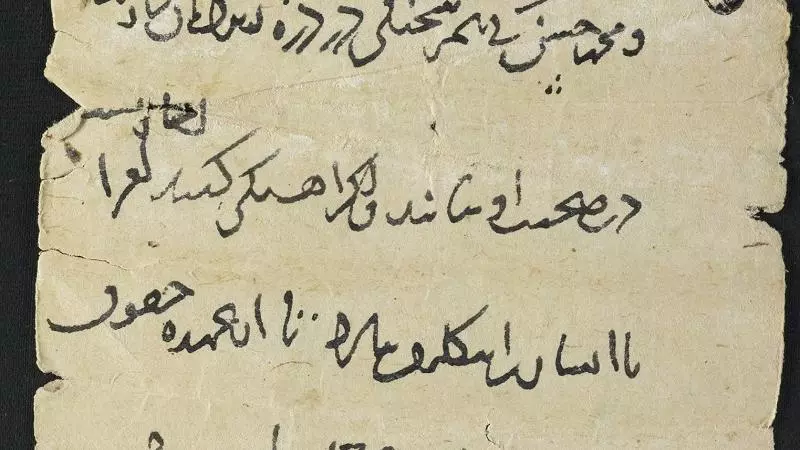

Document of the Month 08/28: Multilingualism, Language Acquisition and Textual Reuse
01 September 2026
What to Speak and How to Write it on the Silk Road:
Evidence from the 13 Texts found in Dunhuang, Western China
by Tasha Vorderstrasse
Summary
This Document of the Month discusses 13 fragments found in Dunhuang, written in Chinese and other languages during the 10th century CE, which are available in the Invisible East Digital Corpus [i] and the International Dunhuang Programme corpus.[ii] These fragments constitute only a small fraction of the thousands of texts recovered from Dunhuang. The close-up view of this small sub-corpus reveals a fascinating social history of how texts were used and reused in the multilingual and cosmopolitan pre-modern world that connected Dunhuang and the Kingdom of Khotan. More broadly, this preliminary study shows how different but interconnected cultural groups managed to negotiate a linguistically complex landscape. The reuse of the fragments reveals their long life-cycle, with changing purposes and uses sometimes dictated by pragmatic needs.
The Political Context: Dunhuang and the Kingdom of Khotan (907-960 CE)
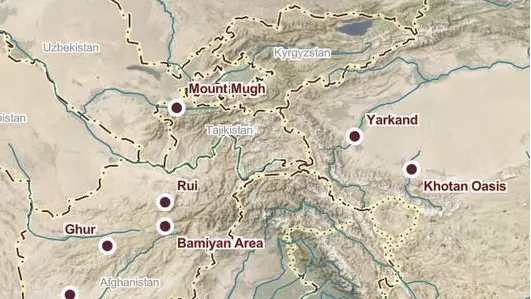
There was a considerable range of languages that were spoken in early medieval Central Asia, resulting in a dizzying array of written sources. This diversity of languages is matched by the rich history of the region where empires and smaller states saw borders, governments, and rulers changed frequently. The Invisible East Digital Corpus (IEDC) helps demonstrate this breadth and scope, with its larger corpus of texts written throughout Iran, Afghanistan and Central Asia in 10 languages and multiple scripts. Most languages are written using one script, but some languages can be written in more than one. In this Document of the Month, I focus on the Chinese-language texts in the Invisible East corpus and what they can tell us about how people were speaking and using Chinese (and other languages) on the eastern end of the so-called Silk Roads.
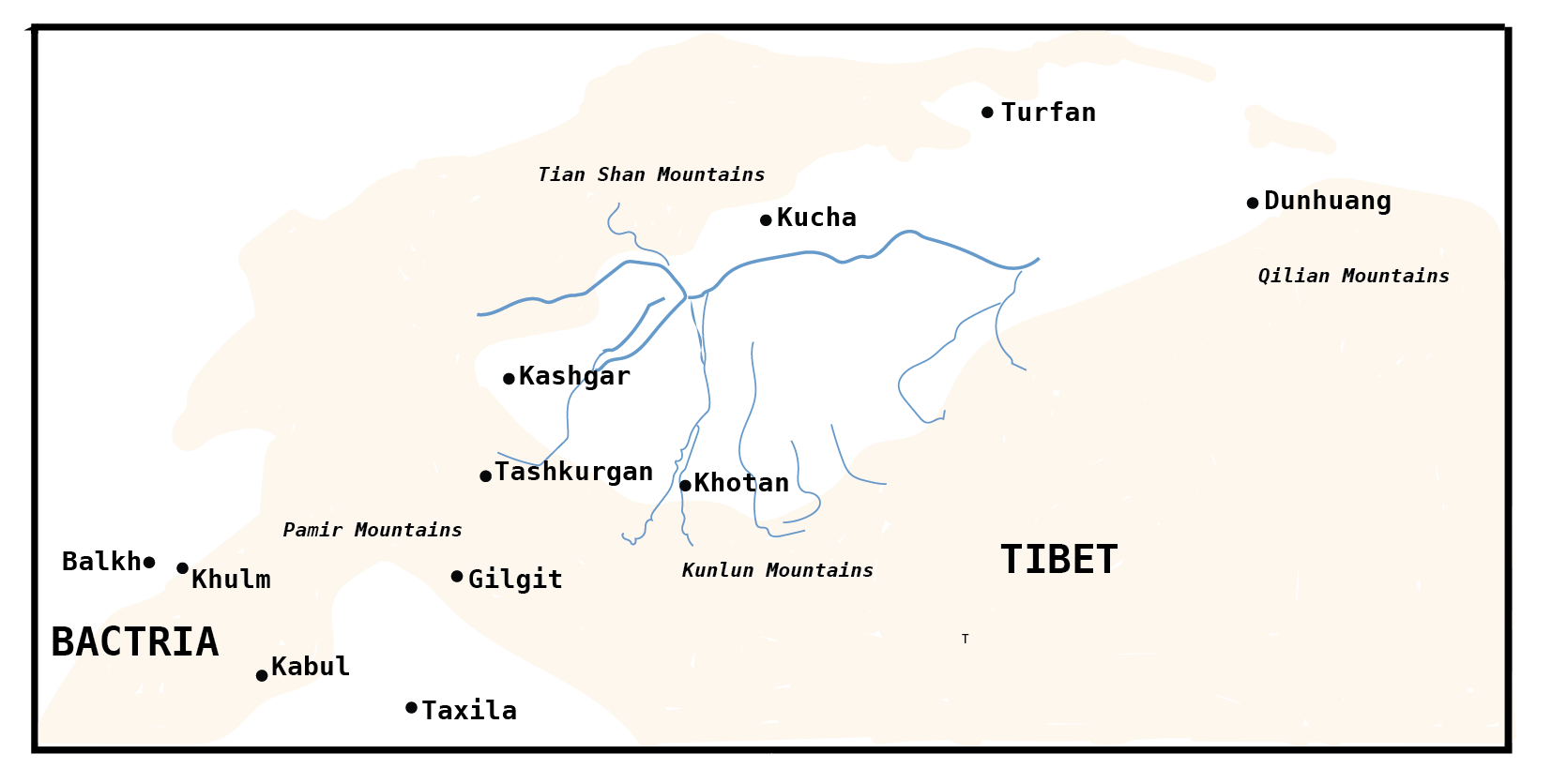
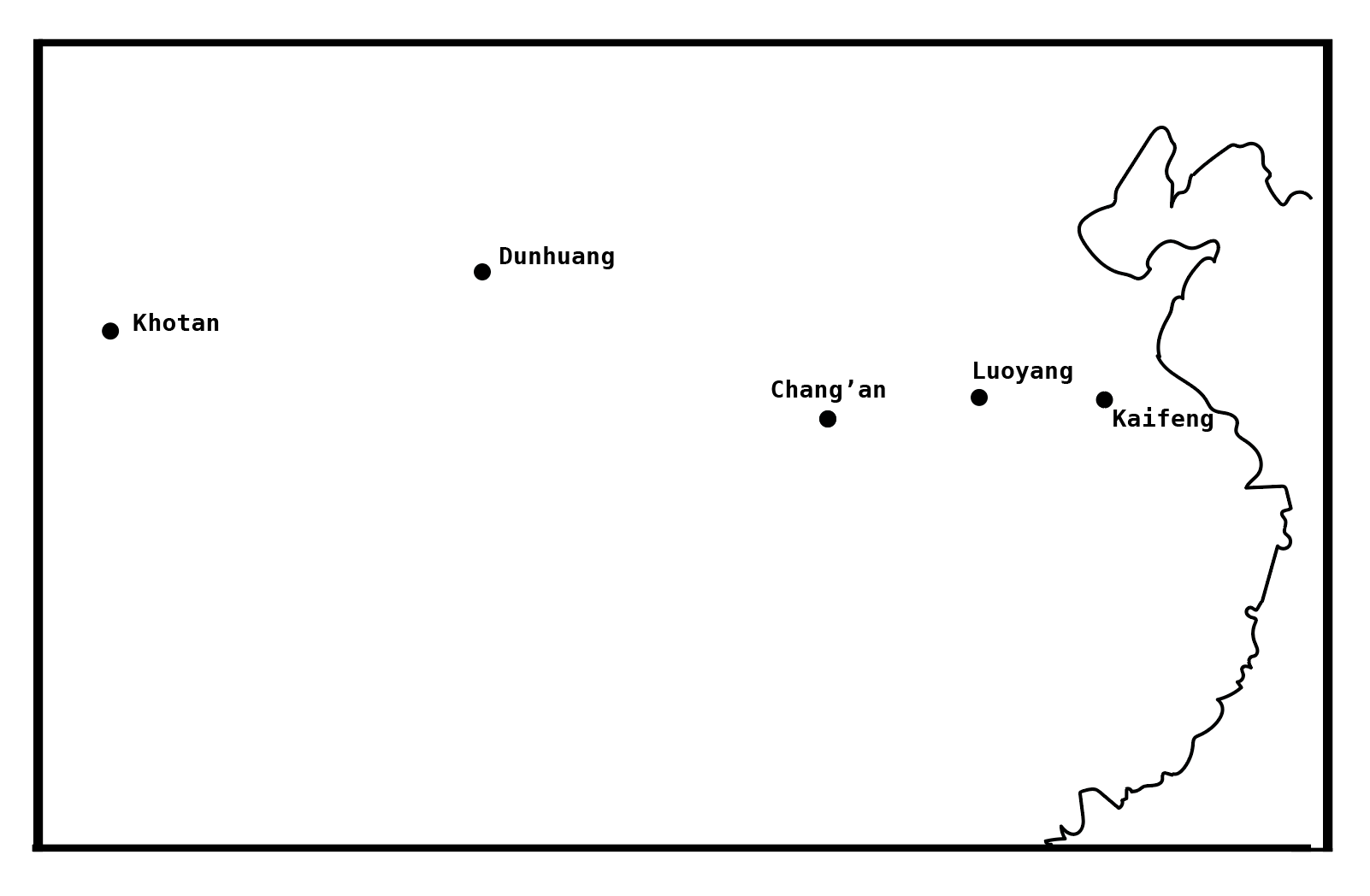
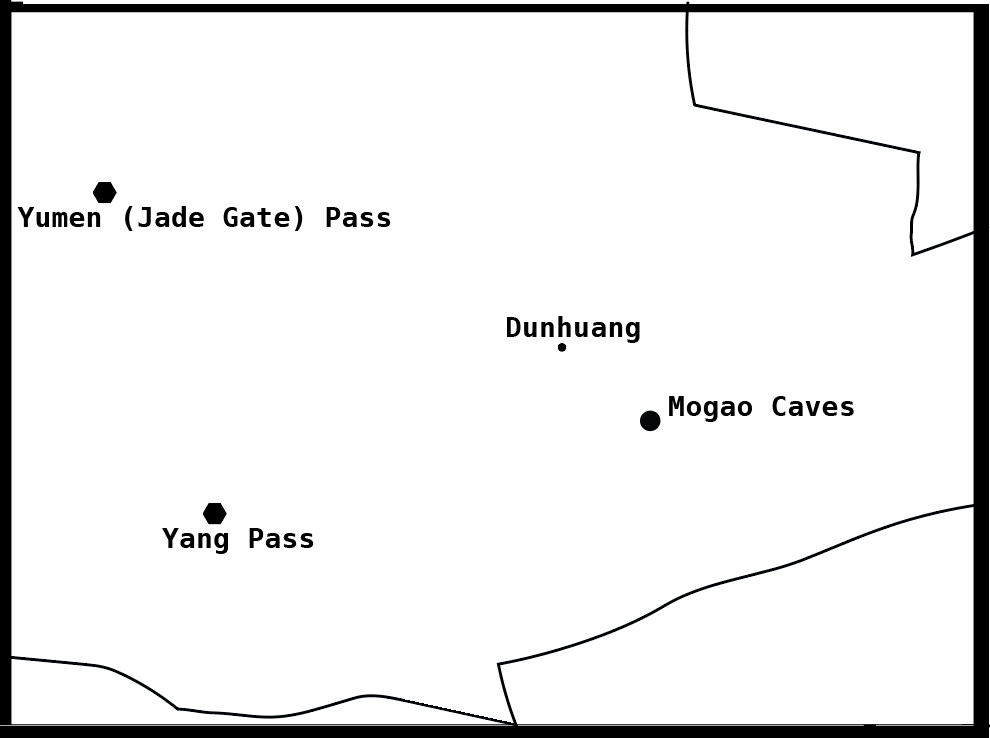
The Chinese-language texts in the Invisible East corpus come from the site of Dunhuang, which is located in northwestern China in Gansu province at the eastern end of the Taklamakan Desert (see fig. 2). The site of Dunhuang was an important settlement that, according to Chinese historians, dates back to the time of the earliest Chinese dynasties, and served as an important merchant and pilgrimage stopping point. While it came under Chinese control in 121 BCE during the time of the Western Han Dynasty’s expansion westwards, the control of Dunhuang changed over time; with control over the region shifting between powers based in central China such as the Han Dynasty (until 220 CE), Three Kingdoms (220–280 CE), Western Jin (266–316), Sixteen Kingdoms (304–439 CE), Northern and Southern Dynasties period (439–581 CE), Sui Dynasty (581–618 CE), Tang Dynasty (618–907 CE) and the Tibetan Empire (618–877 CE). The Tibetan Empire, overlooked by some, was a powerful state which contested control of Central Asia with both the Tang Dynasty in China and the Abbasid Empire based in Baghdad (750-1258 CE). It controlled Dunhuang from 781–848 CE until its forces were expelled by the Chinese general Zhang Yichao (799–872). Zhang took over Dunhuang, and his successors essentially ruled Dunhuang independently during the Guiyijun period (848–1036 CE).
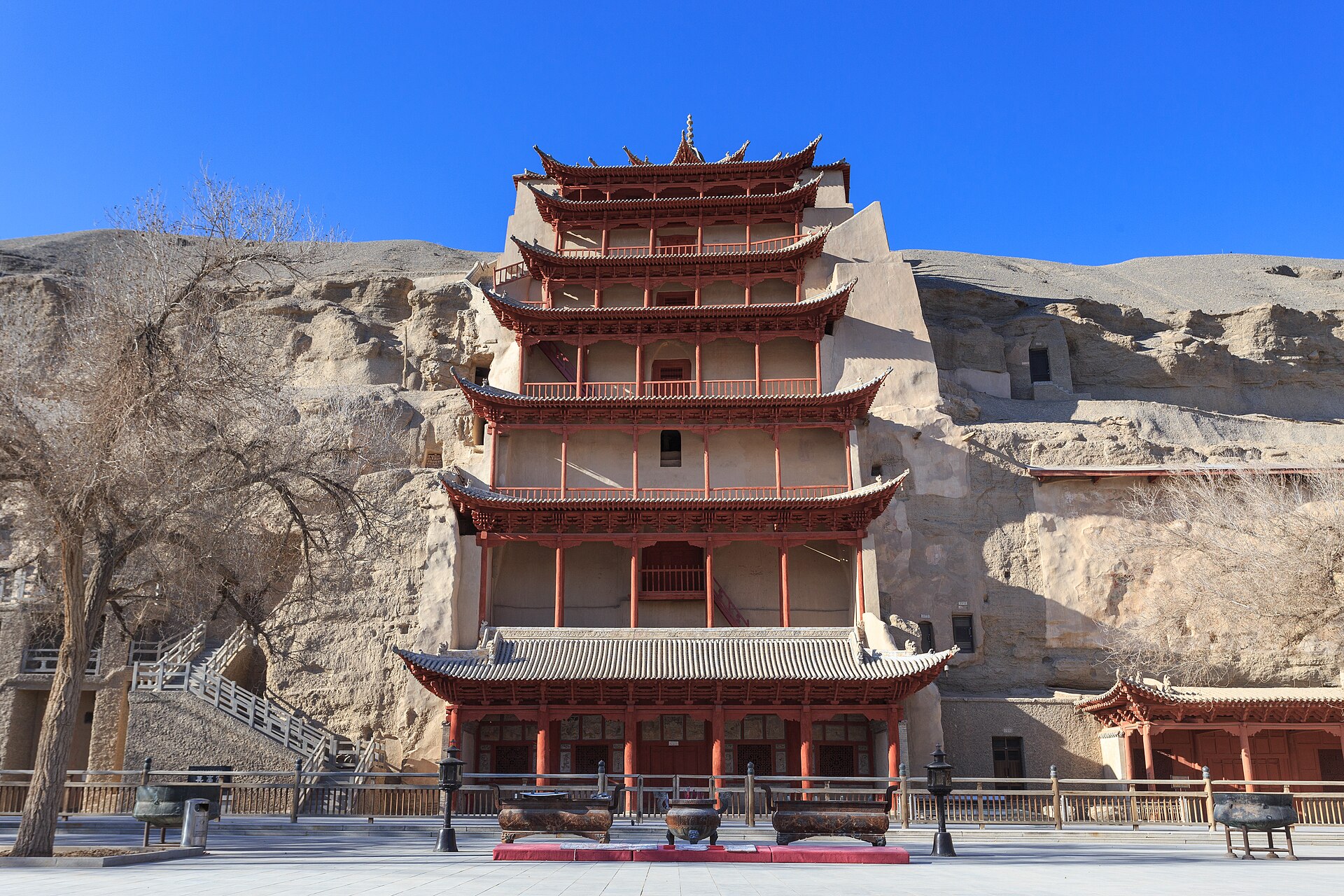
The Dunhuang fragments were found outside the medieval city itself, in the Mogao Caves (see Fig. 4): a conglomeration of hundreds of caves carved into the rock and used for Buddhist meditation. Some of the caves – founded in the 4th century CE, according to legend – were decorated with elaborate Buddhist paintings and sculptures. Buddhist monks from Dunhuang, such as Dharmarakṣa (c. 233–310 CE) and Kumārajīva (344–413 CE), were active in the translation of Sanskrit Buddhist manuscripts into Chinese in both Dunhuang and in key Chinese cities such as Luoyang and Chang’an (see maps in Figs. 1-3). The translation of these texts was an important vehicle for Buddhists to ensure that the new doctrine was followed correctly. There was an awareness that not all Chinese translations of Buddhist texts were accurate which meant there was an impetus to continue to seek out Sanskrit texts and to translate them accurately. The so-called Library Cave contained a huge number of documents, mostly Buddhist in nature, and was sealed around 1000 CE.
The 13 texts featured in the Invisible East Digital Corpus come from multi-lingual and multi-scriptural scrolls written in Chinese and Tibetan (both Sino-Tibetan languages), Khotanese (an Eastern Iranian language), and Sanskrit (an Indo-Aryan language). With Chinese or Khotanese languages The scripts varied: Chinese was usually written in Chinese characters, while Sanskrit, Tibetan, and Khotanese were written in Brāhmī and Brāhmīc scripts.[iii] This plurality reflects the fact that Dunhuang was a cosmopolitan city and home to people from many different linguistic and religious backgrounds. Its traffic included monks, merchants, ambassadors, and others coming from “the West”, passing through Dunhuang on their way to and from the centres of Chinese political power further east. Dunhuang was a unique cultural centre, as well as an important transit node.
IEDC’s documents from Dunhuang: Transmission and Content
The documents were found in the Library Cave of the Mogao complex in 1900 by Wang Yuanlu (1849–1931), a Daoist monk who was conducting restoration there. Of the approximately 100,000 documents found in the cave, over 70,000 were written in Chinese,[iv] and the vast majority being Buddhist texts. After their discovery, they were dispersed and scattered in libraries throughout the world, particularly in London (British Library, BL), Paris (Bibliothèque nationale de France, BnF), Beijing (National Library of China), and St. Petersburg (Institute of Oriental Studies).
The Chinese documents are held in London and Paris (and in one case, the manuscript is split between London (IOL Khot. S. 7) and Paris (BnF P. 5597; see below). Almost all the texts are scrolls, which were first written in Chinese in approximately the 7th–9th century CE, dating to the Sui and Tang periods or during Tibetan rule. Some can possibly be dated more accurately. BnF manuscript P. 2927 features a number of the so-called 'Empress Wu characters', which were new iterations of already existing Chinese characters instituted by the Empress Wu (r. 690–705 CE), and only used during her reign. The texts were then recycled and used again for documents in the late 9th/10th century CE during the Guiyijun period.
Despite the numerical dominance of Chinese-language texts in the collection, scholars tend to focus on texts written in other languages or those which are not Buddhist in nature. Further, the multi-linguality of the texts complicates the editorial task. As a result, scholars sometimes nexglect aspects of manuscripts, such as those written in mulitple languages or ones containing secondary texts written in the same language as the original text.[v]
The Chinese texts written on these documents are Mahāyāna Buddhist texts.[vi] Most were originally written as Buddhist sūtras [vii] in Sanskrit and then translated into Chinese. The translators included Xuanzang (602–664 CE), who journeyed from China to Central Asia and India to collect Sanskrit Buddhist texts and to visit important Buddhist pilgrimage sites between 627 (or 629) and 645 CE. Xuanzang wrote about his travels in the now-famous Da Tang Xiyu Ji, and was also active in translating Sanskrit texts into Chinese. One example of his Chinese translation (titled, Da bore boluomi duo jing) is of the Buddhist Mahāprajñāpāramitā-sūtra written on several manuscripts (BnF manuscripts P. 2855, P. 2782, P. 2927, and BL manuscript Or. 8210/S. 6701).
Recycling of multilingual manuscripts from Dunhuang
Some of these Buddhist scriptures were reused or annotated in other languages for either religious or secular purposes. The manuscripts were written for the Chinese-speaking community, after which they were subsequently reused and written upon in Khotanese, Tibetan, and other languages.
Two examples are:
BL manuscript Or.8210/S.2529 is a Chinese-language copy of one of the most popular Buddhist texts from Dunhuang: the Saddharma Puṇḍarīka Sūtra (Lotus Sutra, Chinese: Fahua jing) translated by Kumārajīva. The text was then turned over and written on in Sanskrit and Khotanese (see below). The Lotus Sutra is also written on Or. 8210/S. 5212 and Or. 8212/162 which were then later reused to write Chinese phrases written in Brāhmī script for Khotanese speakers (see below).
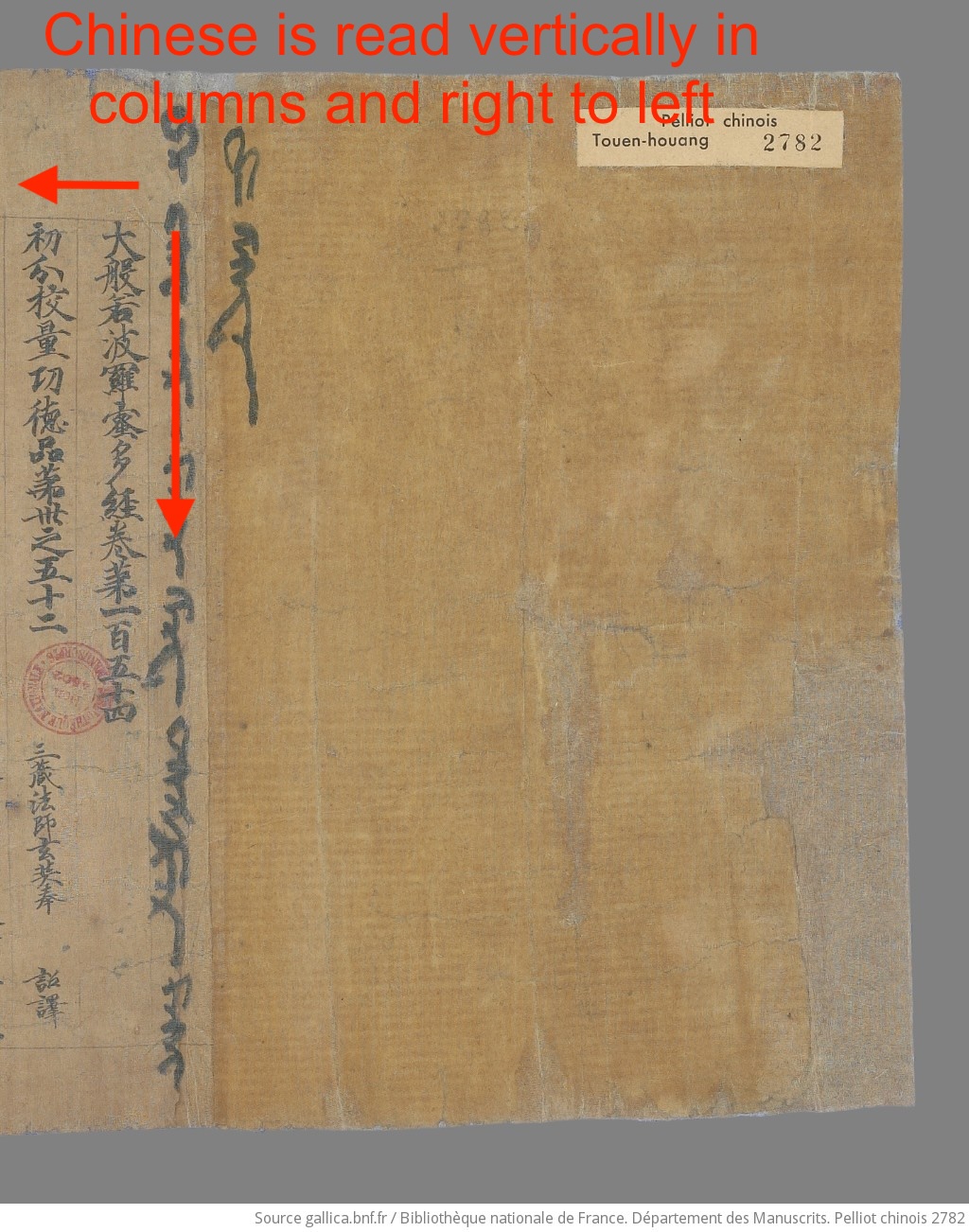
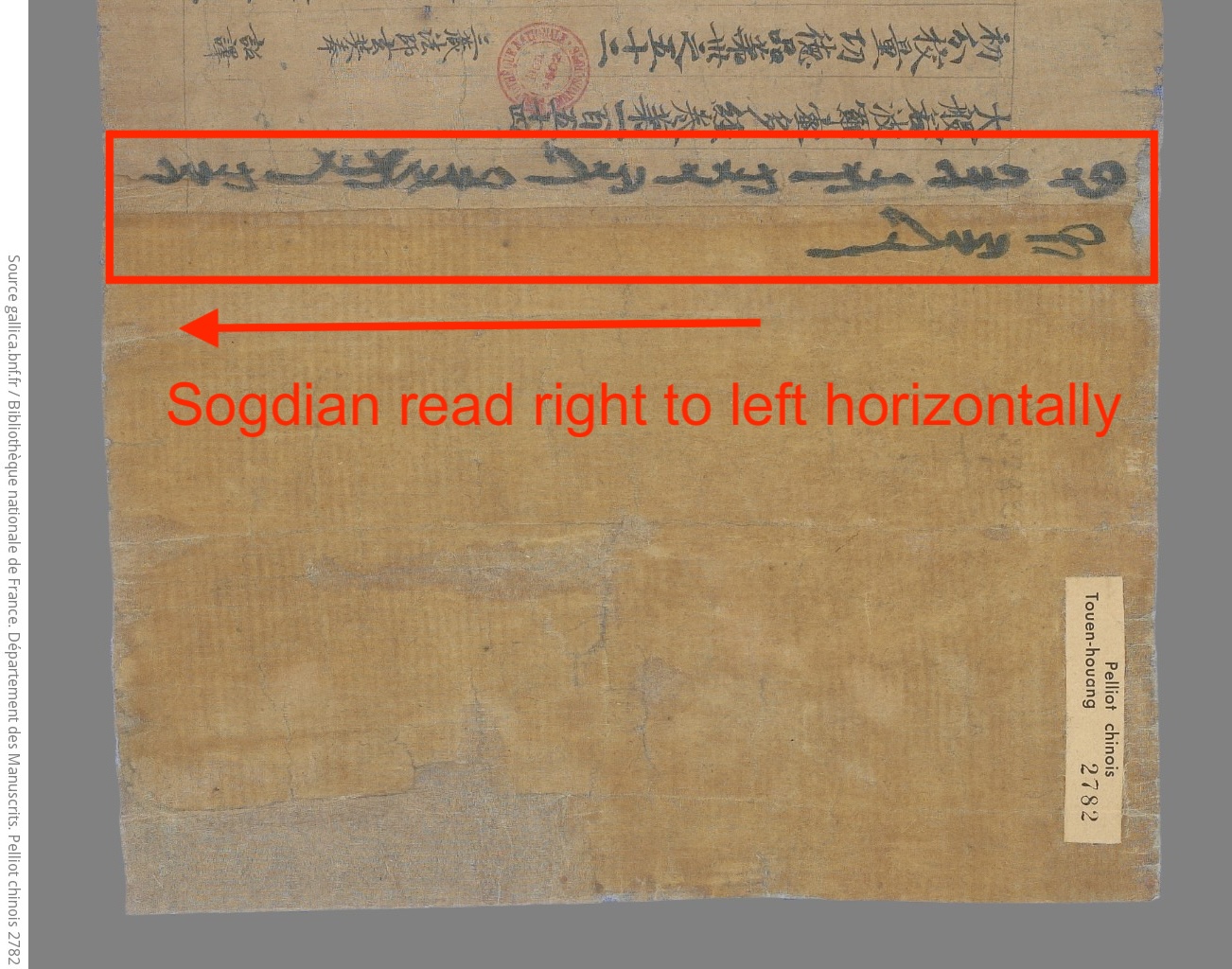
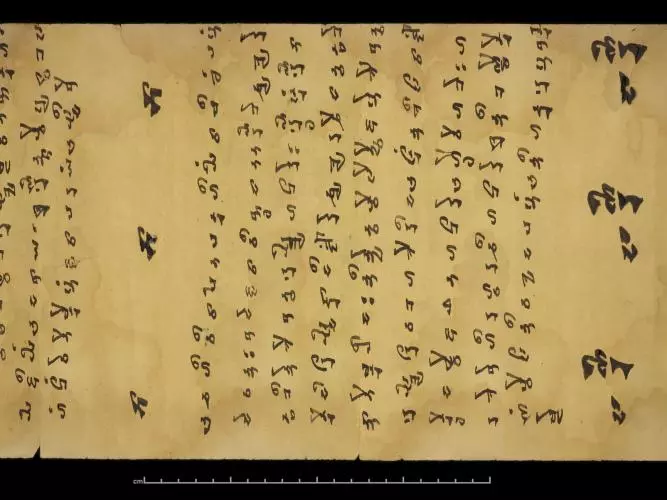
BnF manuscript P. 2782 (Fig. 3) is a Chinese text (Da bore boluomi duo jing) translated by Xuanzang of the Sanskrit Mahāprajñāpāramitā-sūtra features a two-line dedication written in Sogdian (an East Iranian language that uses an Aramaic-derived script) in a different hand. The text was turned 90 degrees to write in Sogdian (which reads right-to-left):“In the name of God. Monkey year, sixth month, (day) 20”.[viii] The scroll was subsequently reused on the other side, which at the time was blank, multiple times. It now contains a summary in Khotanese of the Saddharma Puṇḍarīka Sūtra (Lotus Sutra) with an introduction. That text is followed by a Sanskrit dhāraṇī [ix] text that was commissioned by the Khotanese ambassador Ḍyau Tceyi-śīṅä/Liu Zaisheng (his Khotanese name is used here, see below). Lastly, it contains a letter in the Tibetan language using Khotanese script.
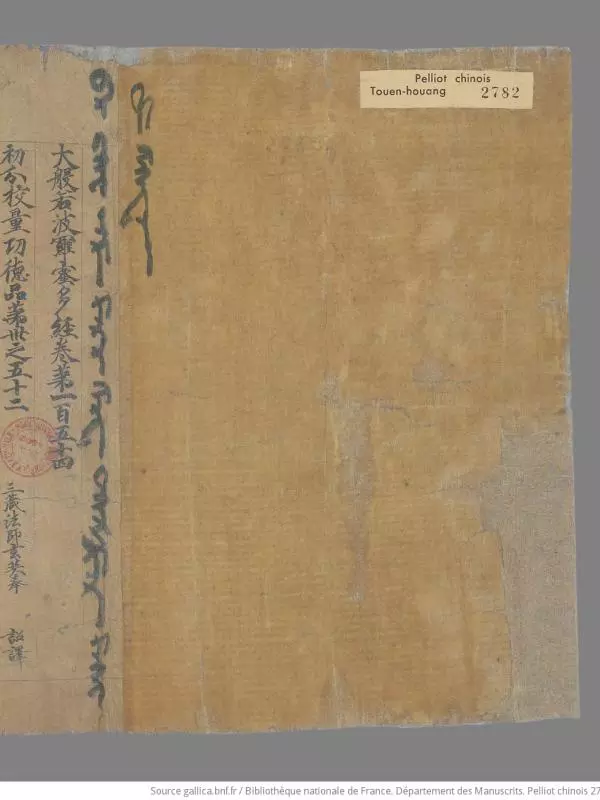
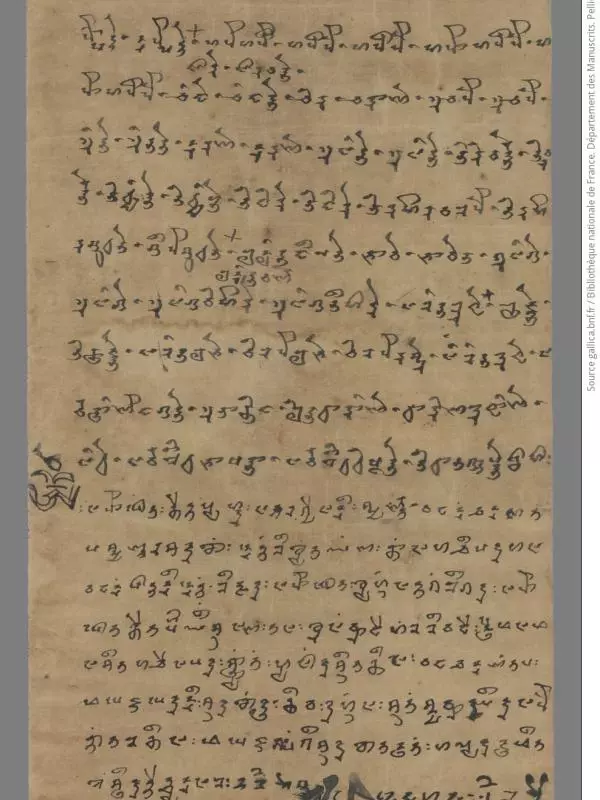
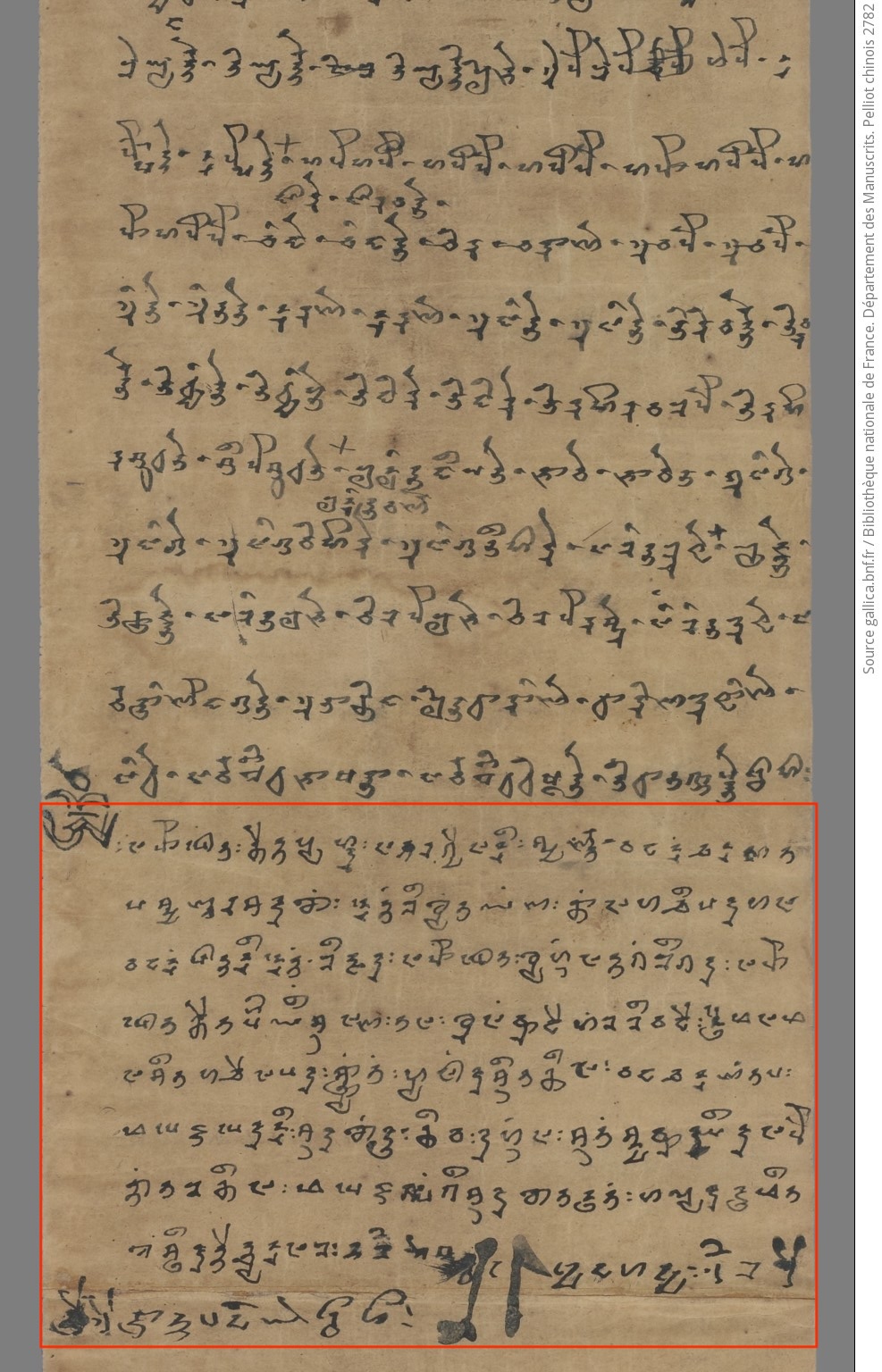
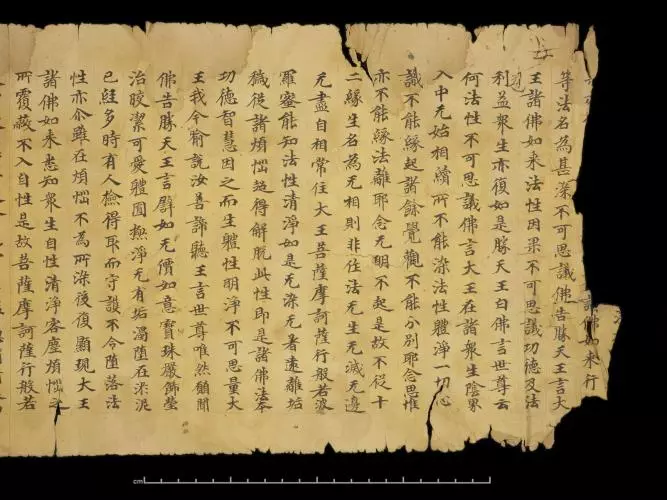
The motivations for the reusing Chinese-language Buddhist scrolls remain unknown. It may have been simply pragmatic – where the Chinese Buddhist original texts were used as convenient scrap paper. However, recent research by Imre Galambos (2026) suggests that the Buddhist texts selected for reuse were all written in a similar hand and format, and were primarily popular texts from the Mahāyāna Buddhist tradition. Galambos argues that these texts were deliberately selected for reuse because of their religious significance, and because they could imbue the subsequent Khotanese writing on the verso with the scroll’s inherent sacred power. Indeed, scrolls were not necessarily meant to be read; the acts of copying and storing them were sufficient to establish their function as sacred objects. The reuse of Buddhist manuscripts in this way has been attested for Tibetan scrolls as well, as noted by van Schaik and Galambos (2012). Further, these scrolls could be very long; while most with some exceptional examples being over 10 metres long, though most are under five. If the point was simply to reuse the scrolls as scrap paper, one would expect the later scribes to cut them into smaller sheets. However, full scrolls were preserved intact even when later scribes did not utilise the entire length (Fig. 5).


The Khotanese Interpolations: One Reuse Method
The Kingdom of Khotan, located in the southwestern part of the Tarim Basin (see map on Fig. 1), was a border-kingdom that, like Dunhuang, fell under the control of a succession of various empires including the Tang Dynasty and the Tibetan Empire. The primary local language, Khotanese, is now an extinct Eastern Iranian language written in a Brāhmic script. Although Khotan was located some 1,345 km from Dunhuang, a considerable number of 9th-10th century Khotanese-language documents have survived in Dunhuang on account of the close ties between the two kingdoms, a bond further cemented by royal intermarriages. Moreover, various Khotanese ambassadors are known to have stopped in Dunhuang on their way to China, such as Liu Zaisheng (Khotanese name: Ḍyau Tceyi-śīṅä) who travelled from Khotan to Kaifeng in China in 943 CE during the Five Dynasties period. Liu Zaisheng / Ḍyau Tceyi-śīṅä is also noted in the Chinese history Xin Wudai shi (New History of the Five Dynasties) as 'bringing tribute to China from the King of Khotan' (74.917–918).
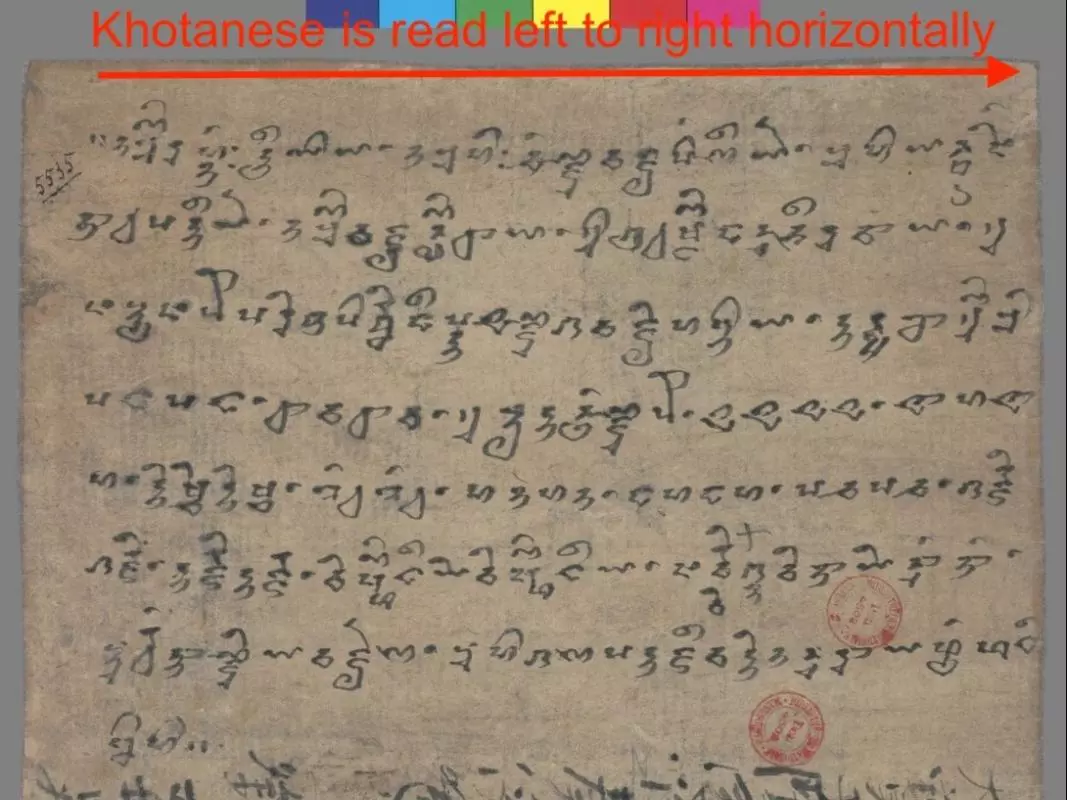
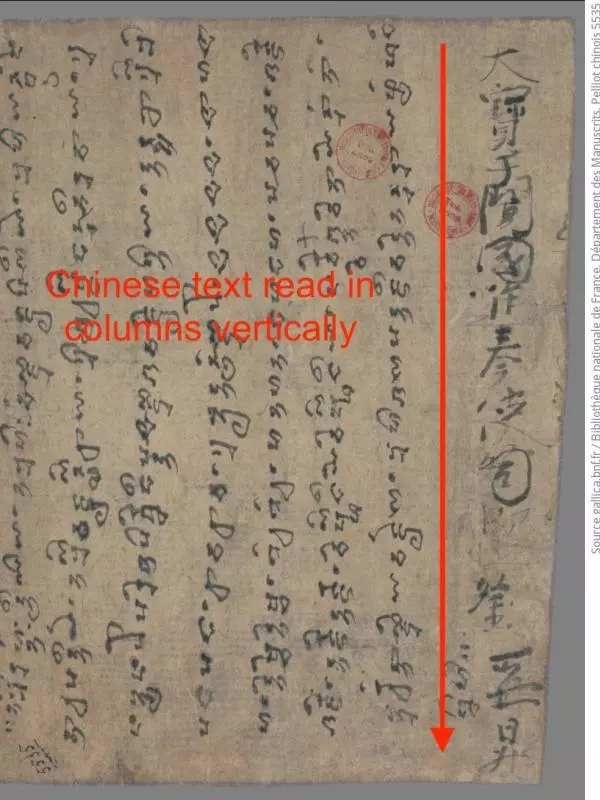
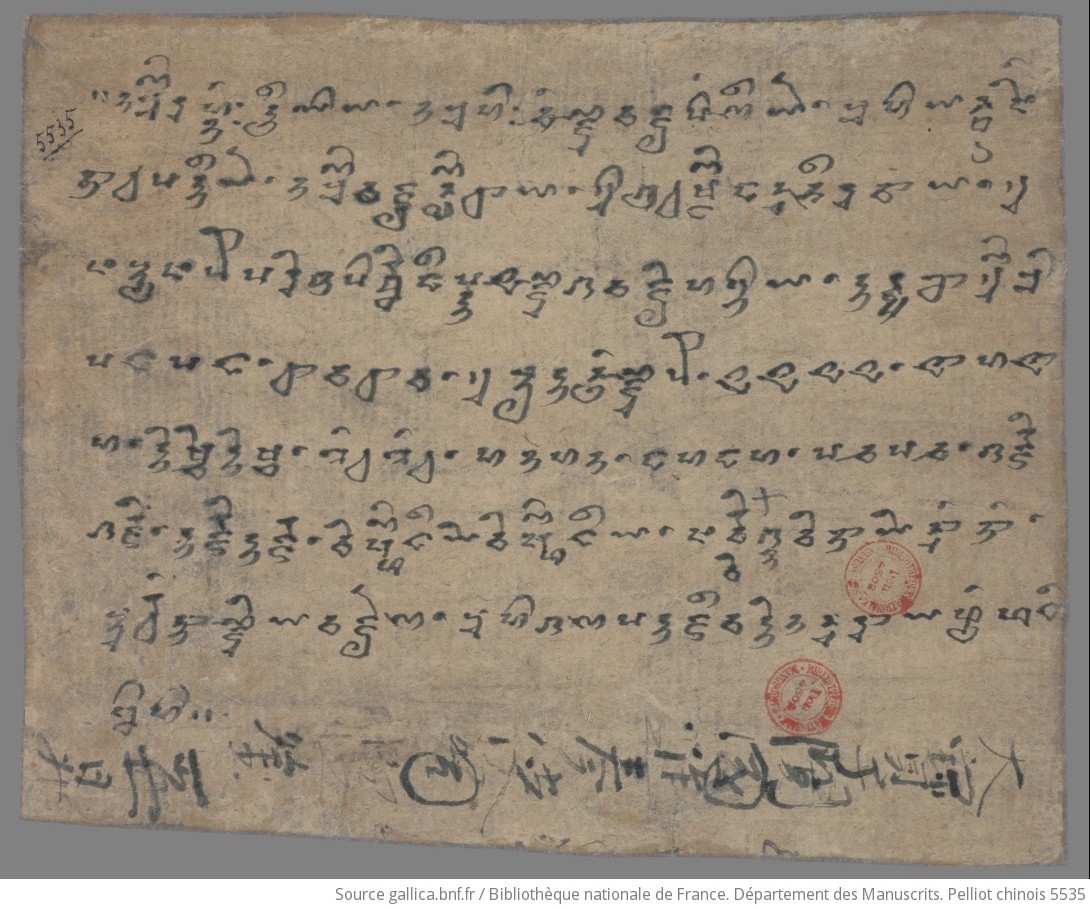
The sub-corpus under discussion here includes one revealing document in this regard: the BnF’s P. 5535 (Fig. 7). It contains a Khotanese rendering of the Buddhist Amr̥takuṇḍalī mantra teext, [x] alongside a note in Chinese which mentions ambassador Liu Zaisheng. The Chinese is written at a 90-degree angle to the Khotanese text. The layout suggests that the Chinese text was intended as a preface to the Khotanese Buddhist text and was added after the Khotanese text had been written. The same ambassador also commissioned the Khotanese metrical summary of the Saddharma Puṇḍarīka Sūtra (Lotus Sutra) on BnF P. 2782 (see above). A partial copy of this metrical summary is also preserved in BL Or. 8212/162.
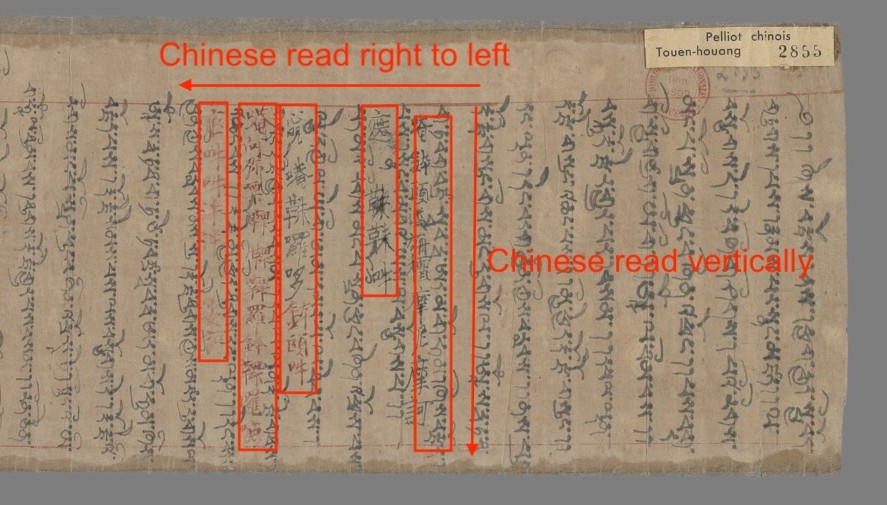
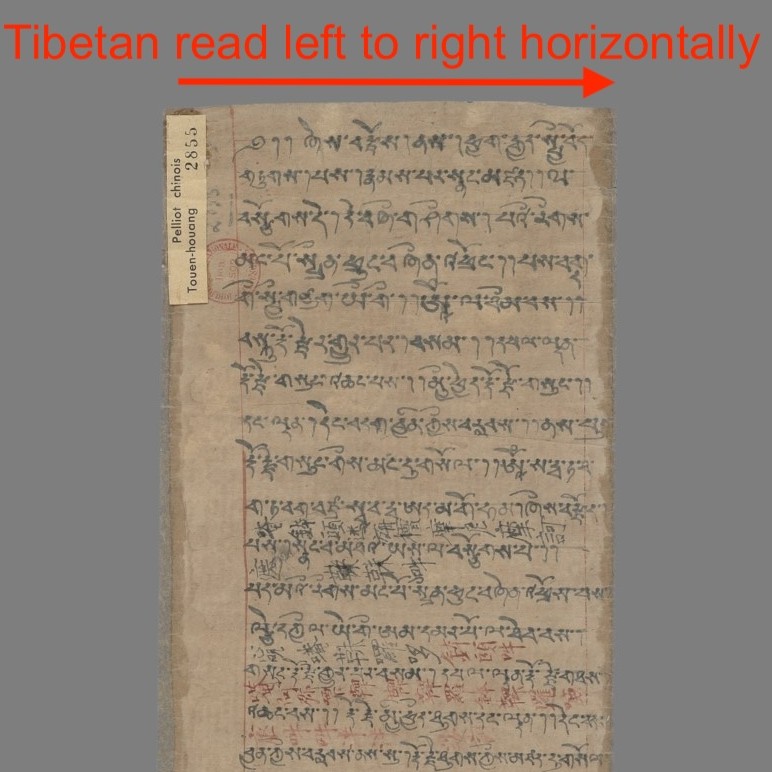
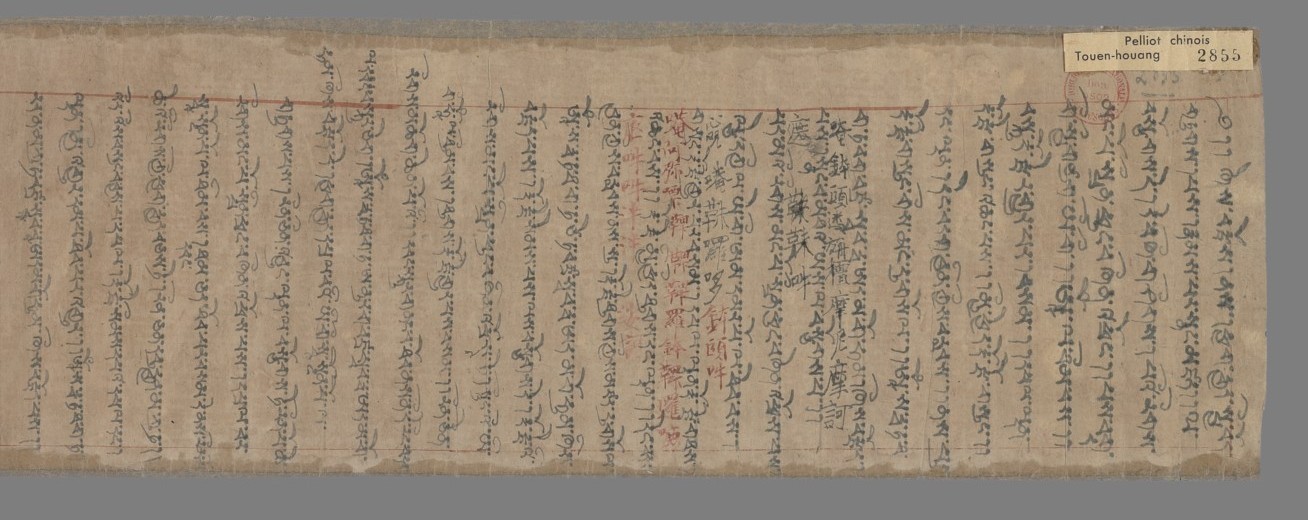
The empty space on the recto side of the scrolls was reused and inscribed with both Buddhist and secular texts. BnF P. 2855 (Fig. 8), for instance, contains Buddhist texts written in Tibetan with interlinear transcriptions of prayers written in Chinese addressed to Buddhist and Chinese divinities, and it also includes a Khotanese Buddhist text added at a later point (see above). Again, however, to read the Chinese characters, one would have to turn the manuscript, since Tibetan is read horizontally and left-to-right. Another example is BL manuscript Or. 8210/S. 2529: the Buddhist Sitātapatrā-dhāraṇī, [xi] this time written in Sanskrit. The fact that this was written by a Khotanese-speaking scribe is indicated by the Khotanese writing at the end: “The Sitātapatrā-dhāraṇī is completely finished.”
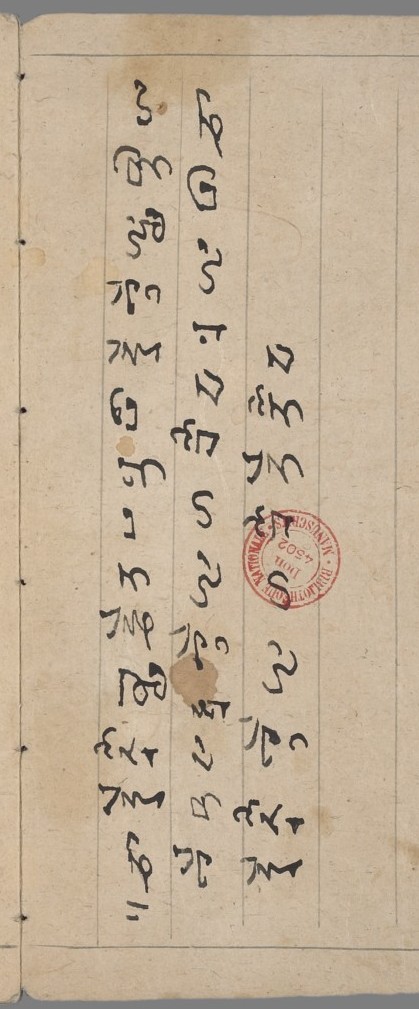
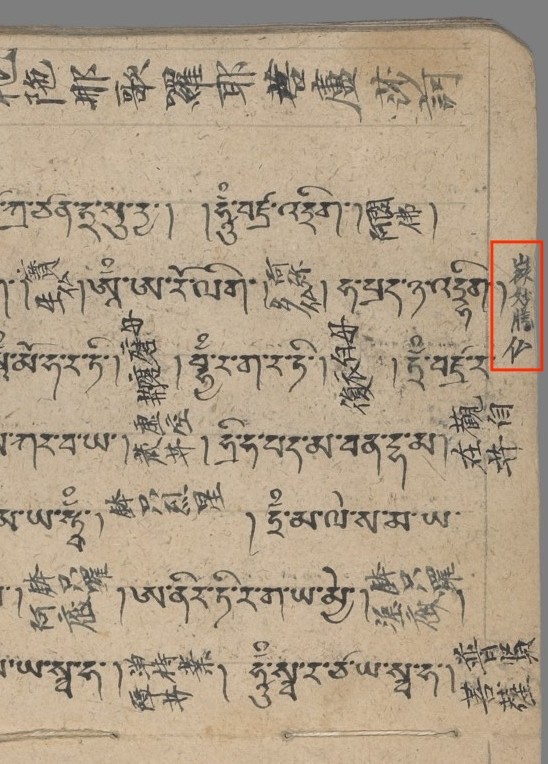
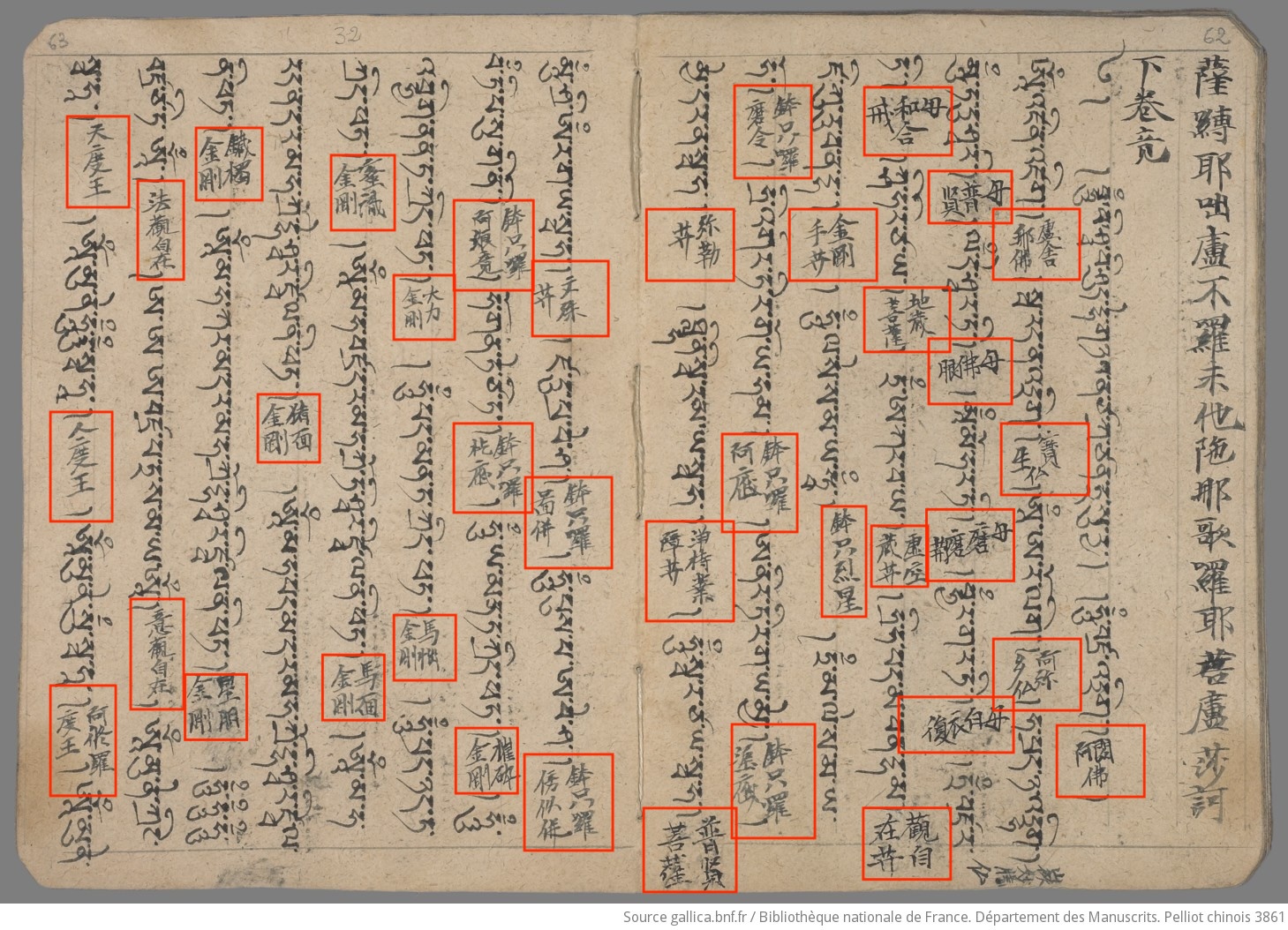
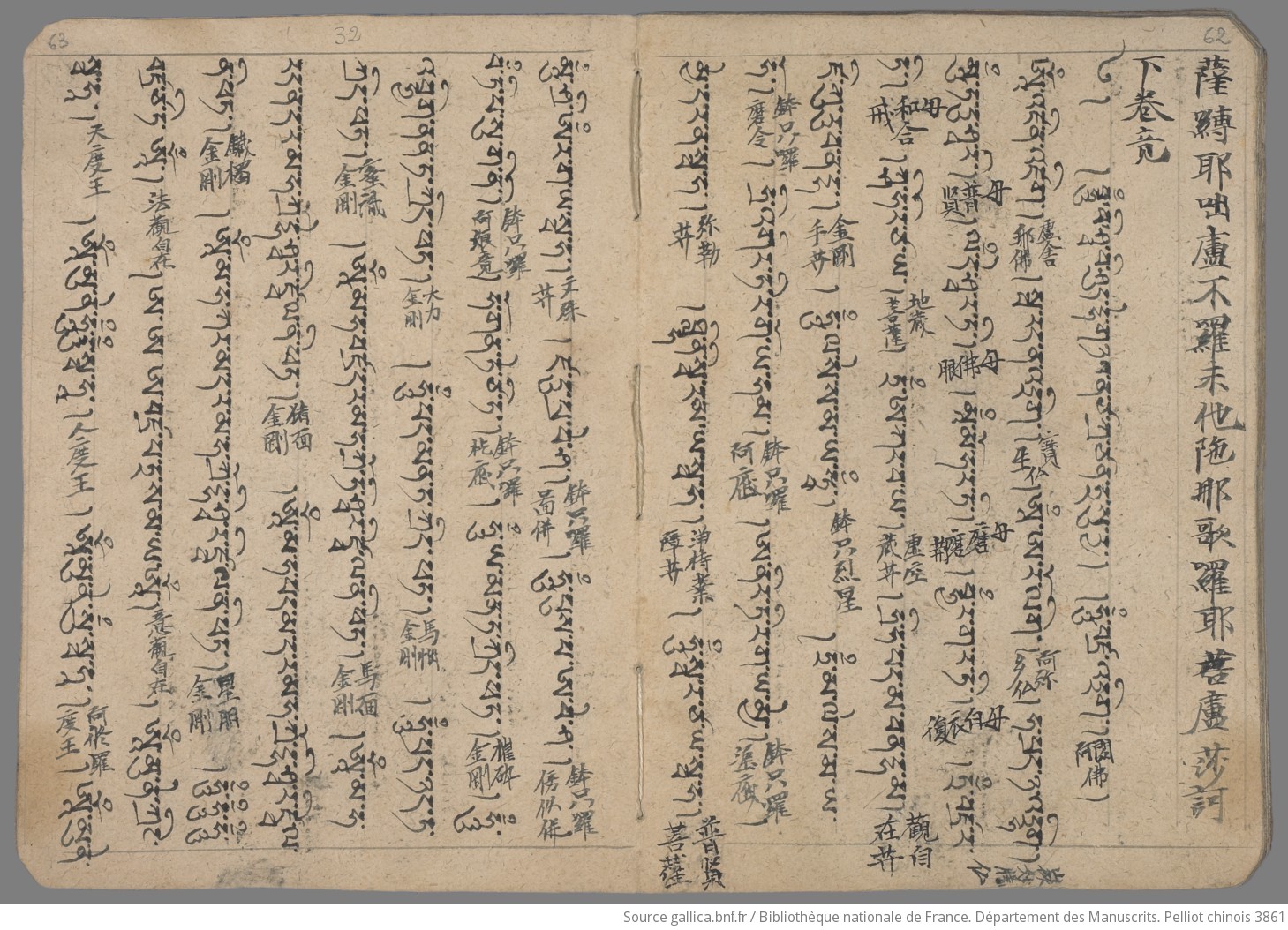
Finally, BnF P. 3861 (Fig. 9) is a noteworthy example of Chinese-Khotanese reuse. It is not a scroll, but rather a folding book constructed by sewing the different pages together. It starts with a Khotanese dedication, followed by Sanskrit written in Tibetan script, some Chinese writing and then finally Sanskrit transliterated into Tibetan with Chinese notations. Sørensen (2019), who has published parts of the Chinese text, has noted that the Chinese used is fairly simple and not as complicated as Tang Dynasty Chinese texts. He suggests that the text might have been a Chinese translation of a Tibetan original which was composed in Dunhuang itself in the late 9th/early 10th centuries CE.
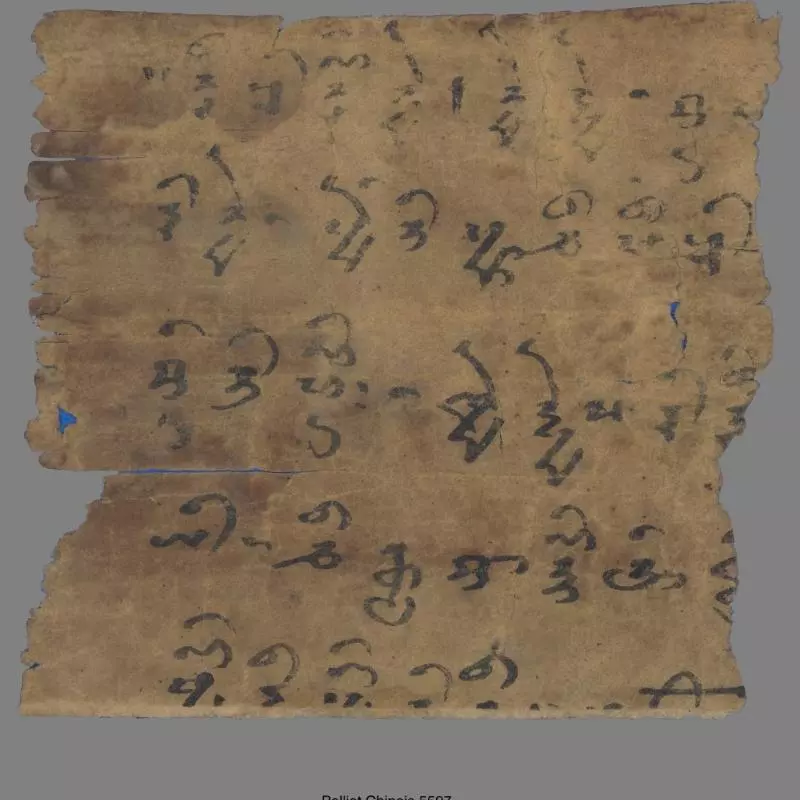
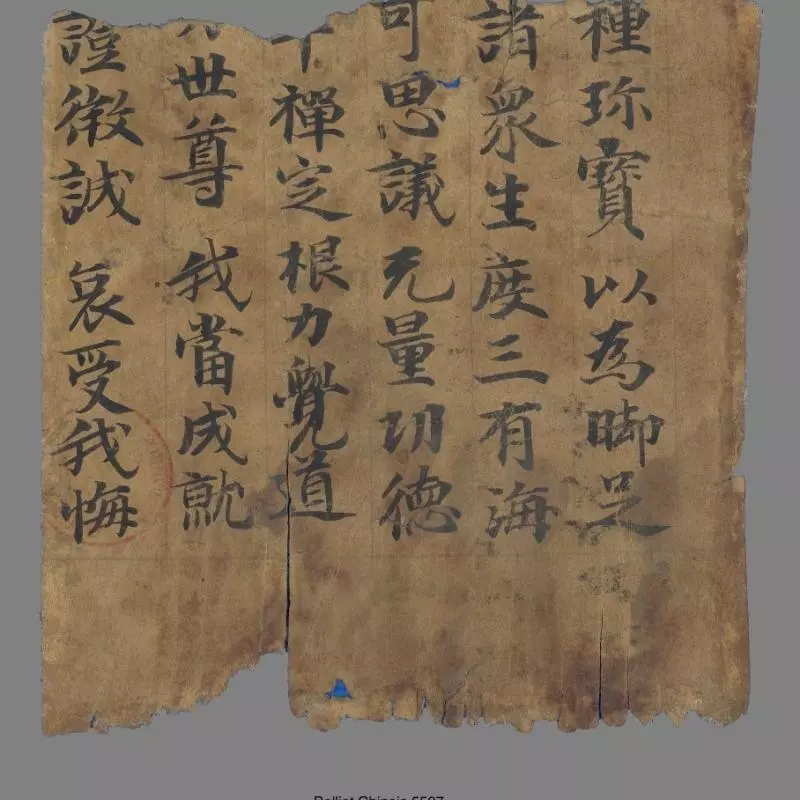
Fig. 10. Fig. 8. BnF P. 5597, Chinese Buddhist text on recto (translation of Suvarṇaprabhāsottamasūtra, Golden Light Sūtra) and Chinese Buddhist text transliterated in Brāhmī script on verso « Source gallica.bnf.fr / Bibliothèque nationale de France »
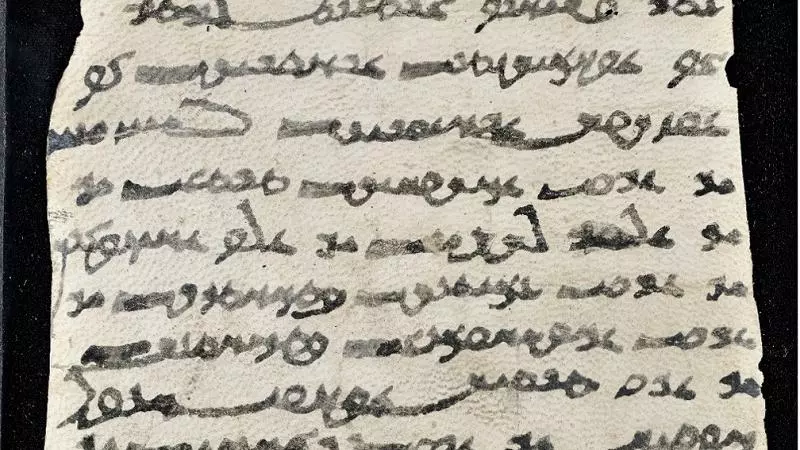
What specific influences can be detected in the Chinese-Khotanese translations? One is the transcription of foreign languages using scripts with which the author or his intended audience were more familiar. One example is Kumārajīva's Chinese translation of the Vajracchedikā Prajñāpāramitā Sūtra (Diamond Sūtra), preserved on two known fragments: BL IOL Khot. S. 7 and BnF P. 5597 (Fig. 10). Rather than being written in Chinese characters, this Chinese-language text is written in the Brāhmī script, which was used normally for Khotanese or Sanskrit! This script switch suggests that the individual involved learned to speak Chinese, but could not write in Chinese characters. A similar phenomenon occured in the contemporaneous Islamicate world. For example, 11th century texts in the Cairo Geniza and the Bamiyan Papers feature texts where Arabic and Persian languages were written in the Hebrew script (referred to as Judeo-Arabic and Judeo-Persian). In the Khotanese context, the use of the Brāhmī script to write Chinese allowed Khotanese-speaking monks to read and write texts in Chinese without having to know Chinese characters.
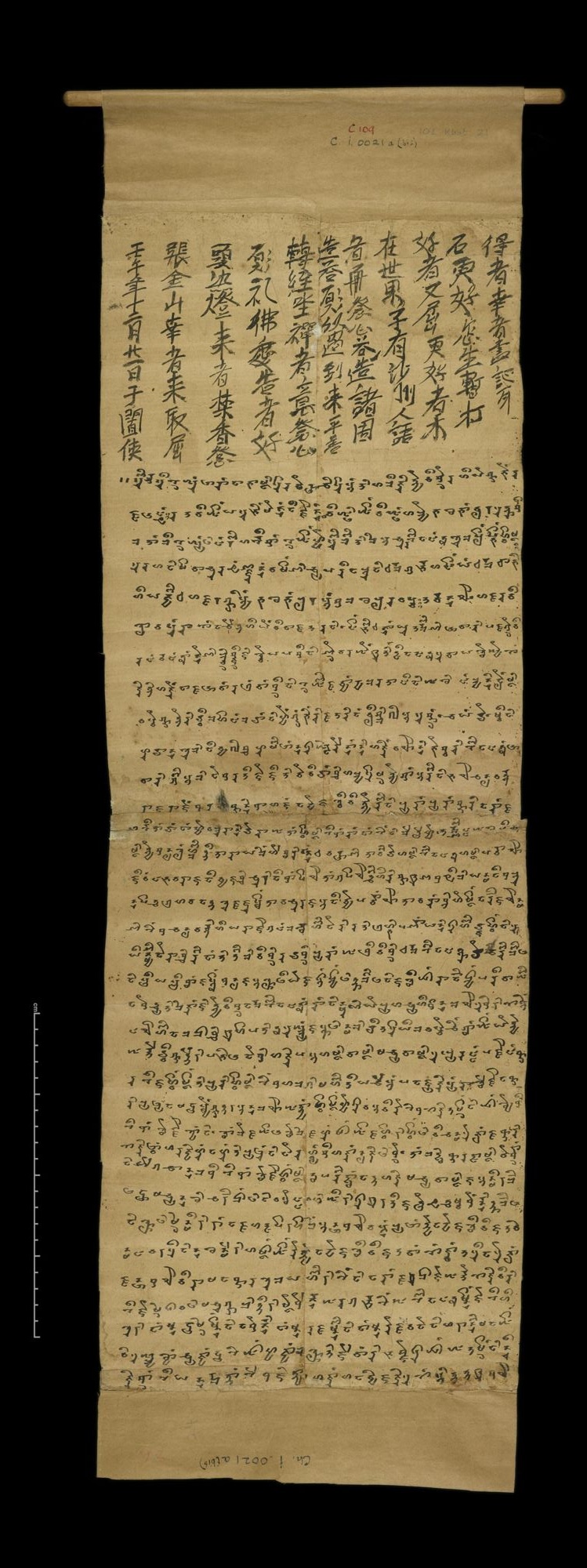
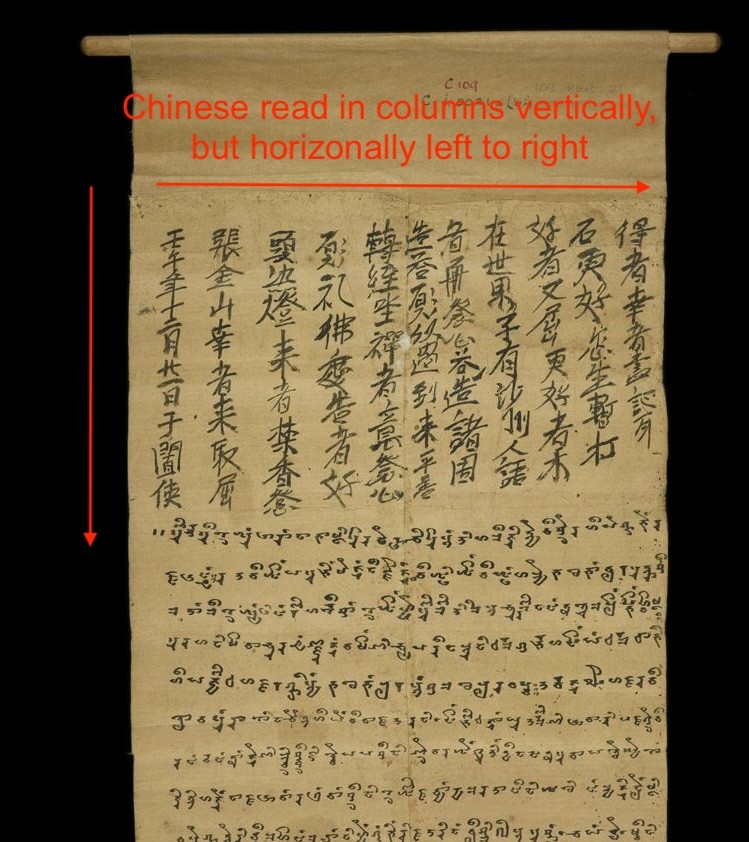
A second influence is palpable in how the text would have been read. As previously noted, given the differences in the directionality of the various scripts, it was often necessary to turn the manuscript to read all the scripts. Sometimes this issue was solved by simply writing the different scripts in the same direction, regardless of how they would usually be written. The manuscript BL Khot. 20 and Khot. S. 21 (Fig. 11) [xii] is revealing here. It concerns individuals travelling from Khotan to Dunhuang, and appears to have been written by a certain Zhang Jinshan (Khotanese: cā kīmä-śąnä), a Khotanese diplomat who journeyed to Dunhuang to arrange the marriage of the King of Khotan to a Chinese princess along with a text that dates to 982 CE and is a panegyric to King Viśa’ Dharma of Khotan (late 10th century CE), once again linking the regions of Dunhuang and Khotan together. The fragment contains a Chinese text of 11 columns which dates to around 922 CE and was written in vertical columns. These would normally be presented and read from right to left, but appear here in the opposite order from left to right which is the way the Khotanese would usually be read. As such, it appears as though the scribe made sure it was unnecessary to turn the book in order to read both the Chinese and the Khotanese.
Translation Aids: A Phrase book?
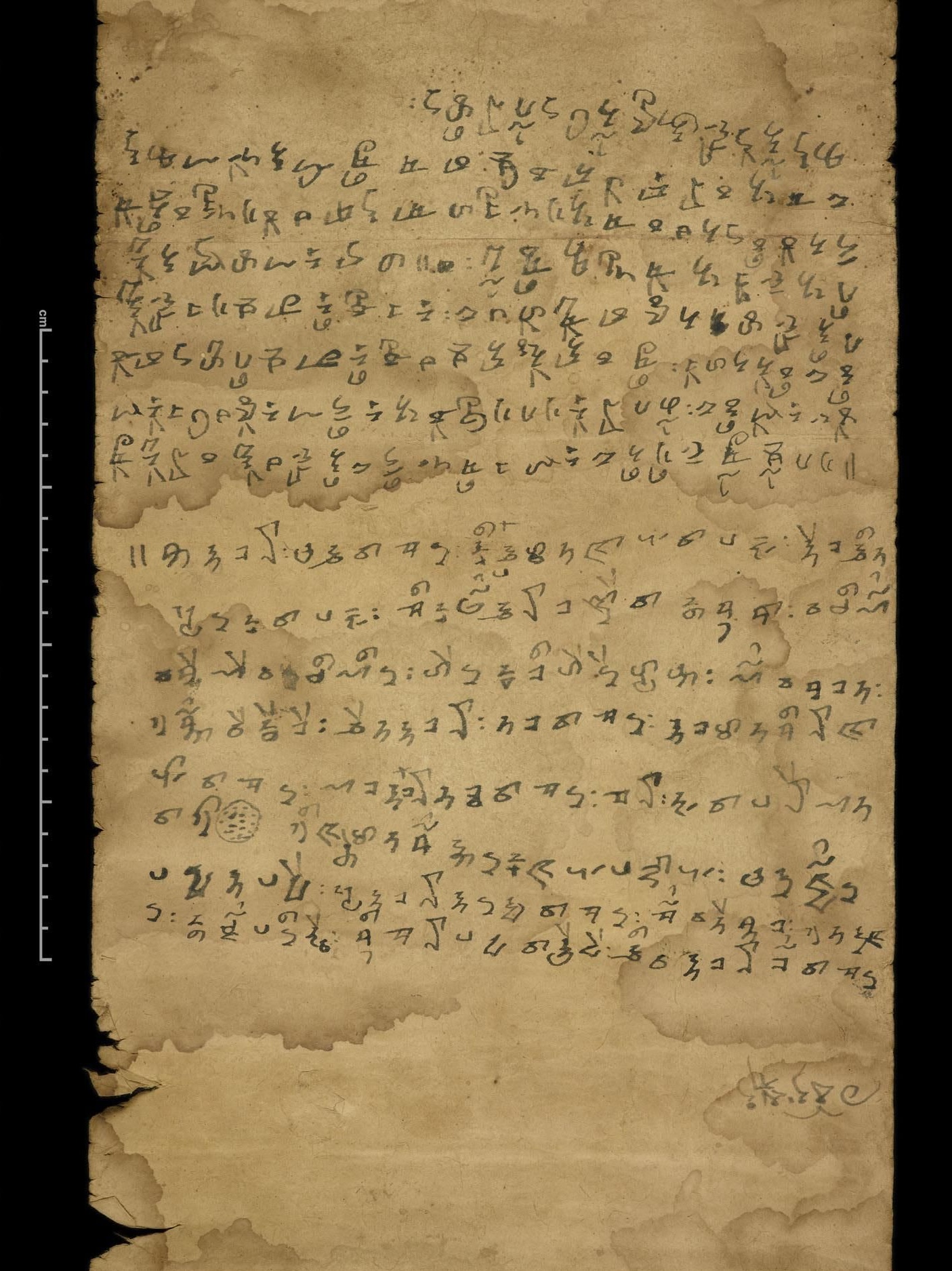
The fact that individuals were trying to communicate between Chinese and Khotanese is also indicated by three other scrolls, BL Or. 8210/S. 5212 (Fig. 12) and Or. 8212/162, and BnF P. 2927. After being used for Chinese sutras (see above), the other side of the scrolls were later reused as Khotanese-Chinese phrasebooks in Brāhmī script that could be used by Khotanese-speaking individuals who needed to know some Chinese phrases, but could not read it. Many of the phrases seem to be useful for travellers. Thus, Or. 8210/S. 5212 glosses phrases, like “bring water!” and “make food for me!” This was followed by a Khotanese note, “in Tibetan,” followed by a Tibetan text that seems to be a letter draft. Or. 8212/162 contains phrases such as “bring me cucumbers!” and “bring me gourd”, and commercial phrases such as “I sell you one cloth.”
Conclusion
The sheer number of Dunhuang texts and their linguistic variety can sometimes feel overwhelming. Focusing on a smaller number of texts, however, allows us to analyse the complexity of these texts, and better understand what they can tell us about the people who lived in the community of Dunhuang, even if they were only temporary visitors. Each of these texts is a micro-history which shows how the documents have evolved over hundreds of years as they were written and rewritten. When we look at Dunhuang, there has been a tendency to see it as a stop on a route to somewhere else. The continued use of the words “Silk Road(s)” when describing Dunhuang as a city shows the continued power of these images of luxury goods traveling along a route. But stopping and looking at the texts in detail helps us look beyond this one-dimensional view of the cosmopolitan and multilingual city and better understand the use and reuse of manuscripts.
Notes
[i] These fragments are the ones that appear if one searches the term “Chinese” in the IEDC. The fragment in the Museum of Renmin University in China (GXW0284) is excluded here because it does not have a secure findspot. Search the term “Chinese” as the primary language in the database reveals two parts of the same manuscript (BnF P. 5597 and BL Khot. S. 7, for which see more below). Searching “Chinese” as an additional language and “Dunhuang” reveals 103 examples; an analysis of all these fragments is beyond the scope of the discussion here.
[ii] The International Dunhuang Programme (IDP) (formerly the International Dunhuang Project) is an international collaboration of partner institutions including libraries, museums, and research institutes. The purpose of this project is to provide information and images about the Eastern Silk Roads. The Invisible East corpus contains brief descriptions of all the documents discussed here but no photographs; most of the documents have been digitsed and are available on the IDP.
[iii] The term “Brāhmīc scripts” describes writing systems used in Southeast and East Asia (including Tibetan and Khotanese) which derive from the Brāhmī script used to write Sanskrit and other languages. It is generally believed that the Brāhmī script derives from the Aramaic script which spread into Central Asia during the Achaemenid period (550–330 BCE).
[iv] The language of these documents is Middle Chinese, rather than standard modern Chinese. That people in Dunhuang were learning and speaking Chinese is evident from Chinese-language school texts found amongst the manuscripts in the Library Cave, and from school texts in Chinese inscribed on the walls of the Mogao caves themselves.
[v] Although the Khotanese of all the texts have been transliterated by Bailey (1945–1967), he does not provide any translations of these texts in those volumes, although he does publish translations of some elsewhere. The British Library texts have now been translated by Skjærvø.
[vi] A branch of Buddhism that developed in India and spread to Central Asia and beyond to the Taklamakan Desert and central China. Defining Mahāyāna Buddhism precisely remains problematic as Silk (2002) has noted, but essentially there is a belief that all people can become enlightened. The bodhisattvas, persons who are seeking or have reached enlightenment, delay their own nirvana (ultimate form of salvation) in order to help others become enlightened.
[vii] Sūtras are teachings, which are thought to be by Buddha or his disciples.
[viii] Sogdian is here written in an Aramaic-derived script. The editors of the Sogdian text argue that the person who wrote this was not Buddhist but probably a Christian, although they also do not exclude that the writer could also be Muslim. A more detailed assessment this author's religion is beyond the scope of the discussion here.
[ix] Incantation or recitation.
[x] A Buddhist mantra is a sound or syllable or words that are meant to be chanted repetitively and thought to focus one’s mind.
[xi] This is an incantation in the name of the Bodhisattva Sitātapatrā, invoked for protection.
[xii] These two shelfmarks were originally part of the same manuscript that were sewn together and have since been separated.
Bailey, Harold Walter. Sad-dharma-puṇḍarīka-sūtra : The summary in Khotan Saka. Australian National University. Faculty of Asian Studies. Occasional paper 10 (Canberra, 1971).
1965 “A Metrical Summary of the Saddharmapuṇḍarīkasūra in Gostanadeśa.” Bulletin of Tibetology 2 (1965): 5–7.
Khotanese Texts I-VI (Cambridge, 1945–1967).
Chen Ruixuan. “Buddhism in Khotan.” In Encyclopedia of Buddhism, Volume VI: History, Part 2: Central and East Asia, ed. Jonathan A. Silk, Richard Bowring, and Vincent Eltschinger, 3–17 (Leiden, 2023).
“Lurching Towards a Canon Mahāyāna Sūtras in Khotanese Garb.” Entangled Religions 11 (2020).
Emmerick, Roland E. and Edwin G. Pulleyblank. A Chinese Text Written in Central Asian Brahmi Script: New Evidence for the Pronunciation of Late Middle Chinese and Khotanese. Serie orientale Roma LXIX (Rome, 1993).
Fellner, Hannes A. “Khotanese as a Language of the Tarim Borderlands.” Religions 17 (2026).
Galambos, Imre. “Rethinking Manuscript Reuse: Sino-Khotanese Scrolls from Dunhuang.” Religions 17 (2026): 1–16.
2024. “Chinese primers along the North-Western Frontier.” Journal of the Royal Asiatic Society 34 (2024): 711–728.
“Dunhuang Characters and the Dating of Manuscripts.” In The Silk Road: Trade, Travel, War and Faith, ed. Susan Whitfield with Ursula Sims-Williams, 72–79 (London, 2004).
Goodman, Amanda. A Multilingual Manuscript from Dunhuang: P3861.
Guo Li and Zhang Xiantang. “Uncovering the Secrets of a New Archaeological Case at Dunhuang—A Textual Study on the Newly Found Qianzi Wen Written on the South Wall in Mogao Cave 9.” Cultural and Religious Studies 10 (2022): 281–298.
Hansen, Valerie, The Silk Road: A New History (Oxford, 2012).
Hao Chunwen and Wu Shaowei. “The Circulation of Texts between Dunhuang and Other Regions as Viewed from Dunhuang Manuscripts.” In Beyond Silk and Book Roads: Rethinking Networks of Exchange and Material Culture, ed. Michelle C. Wang and Ryan Richard Overbey, 151–193, Studies on East Asian Religions Volume 11 (Leiden, 2023).
Høisæter, Thomas Larsen. “Forms of Mobility in the Southern Tarim Basin in the 7th to the 10th Centuries.” Medieval worlds 20 (2024): 17–36.
Katayama Yumi. 2014. “The Khotanese Summary of the Saddharmapuṇḍarīkasūtra and the Saddharmapuṇḍarīkopadeśa.” Acta Tibetica et Buddhica 7 (2014): 83–102.
Maggi, Mauro. “Local Literatures: Khotanese.” In Brill’s Encyclopedia of Buddhism Online, ed. Jonathan A. Silk, Richard Bowring, and Vincent Eltschinger (Leiden, 2020).
van Schaik, Sam. 2014. “Phrasebooks for Silk Road Travelers.” IDP Blog. Updated version from 2014 on Early Tibet.
van Schaik, Sam and Imre Galambos. Manuscripts and Travellers: The Sino-Tibetan Documents of a Tenth-Century Buddhist Pilgrims, Studies in Manuscript Cultures Volume 2 (Berlin and Boston, 2012).
Silk, Jonathan. "What, if anything, is Mahāyāna Buddhism? Problems of Definitions and Classifications.” Numen 49 (2002): 355–405.
Sims-Williams, Nicholas and James Hamilton (translated by Nicholas Sims-Williams) with an appendix by Wen Xin. Turco-Sogdian Documents from 9th-10th Century Dunhuang, Corpus Inscriptionum Iranicarum 2/5 (London, 2015).
Skjærvø, Prods Oktor, Khotanese Manuscripts from Chinese Turkestan in the British Library: A Complete Catalogue with Texts and Translations, Corpus Inscriptionum Iranicarum 2/5 (London, 2002).
Skjærvø, Prods Oktor & Emmerick, Ronald E. "BUDDHISM iii. Buddhist Literature in Khotanese and Tumshuqese." In Encyclopaedia Iranica (2000).
Sørensen, Henrik H. "Tibetan Tantra and Chinese Esoteric Buddhism in the Melting Pot: A Study of a Chinese Recension of the Twenty-Eight Vajra Precepts." BuddhistRoad Paper 2.2 (2019). https://d-nb.info/1207545821/34
Wen Xin. 2023. The King’s Road: Diplomacy and the Remaking of the Silk Road (Princeton, 2023).
Cite this article
Vorderstrasse, T. 2026. "What to Speak and how to Write it on the Silk Road: Evidence from the 13 Texts found in Dunhuang Western China". Eds. M. Arghandehpour and A. Azad. Document of the Month. Invisible East. doi: XX
About the author
Tasha Vorderstrasse is the University and Continuing Education Program Coordinator and Research Associate at the University of Chicago. Her research focuses on the material culture of the Near East, south Caucasus, and Central Asia and the relationship between these areas and China.
The online series, Document of the Month, presents some of the most interesting and revealing medieval documents from the desks of Invisible East researchers and their colleagues worldwide. Each piece in the series is dedicated to a single document or a closely related group of documents from the Islamicate East and tells their story in an engaging and accessible way. You will also find images, editions and translations of the documents. If you would like to contribute to the Document of the Month series, please, get in touch with the team.