
Document of the Month 9/26: Of Selling and Kindling: Analogy at a Linguistic Crossroads
02 October 2026
Analogy in Motion: Language Change as Seen in a Persian Document from Bamiyan
by Milad Abedi
Summary:
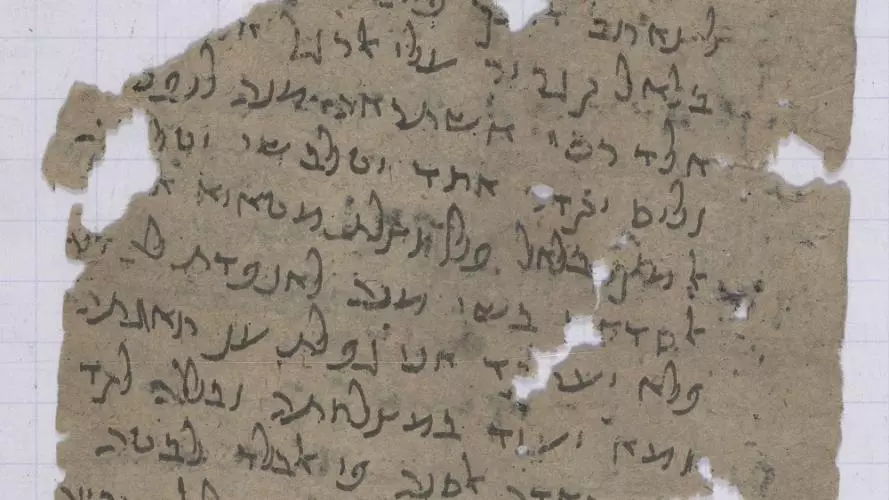
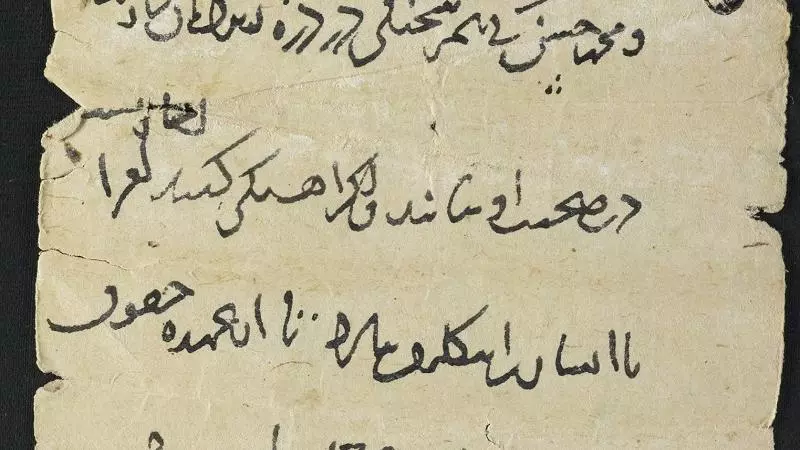
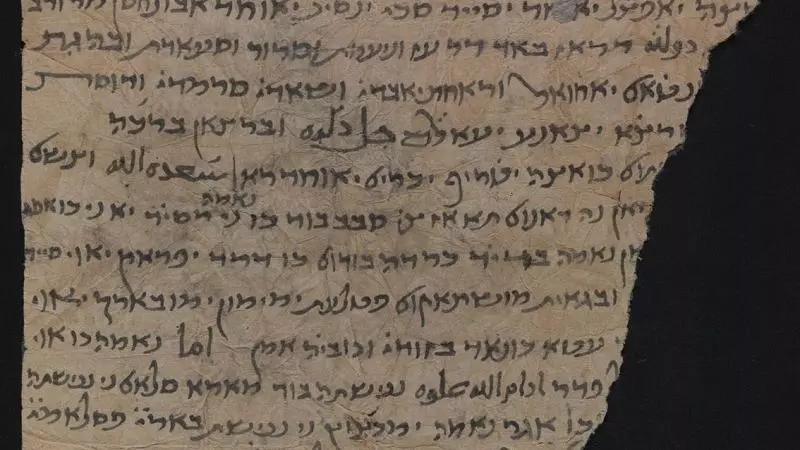
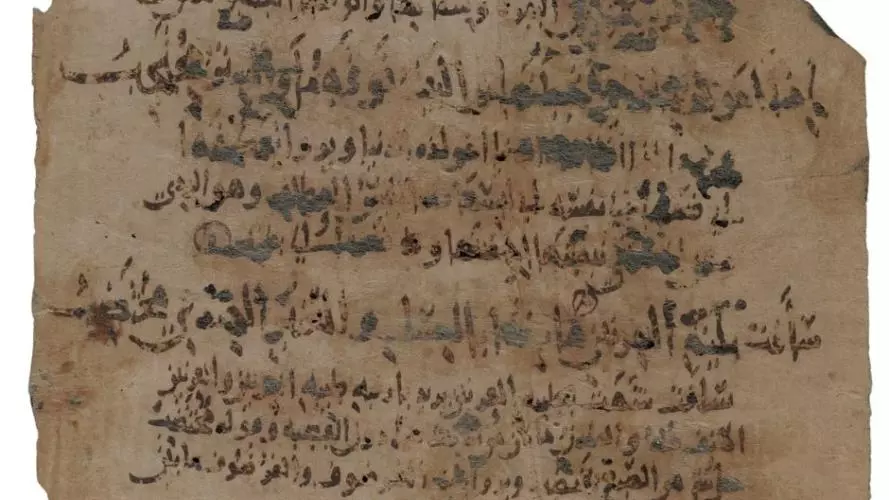
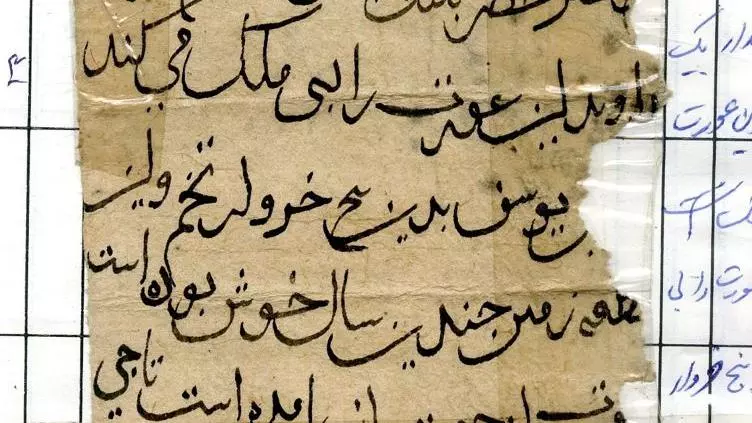
This month’s document is a Persian fragment from the Bamiyan Papers held at the National Library of Israel (shelfmark Ms.Heb.8333.214, recto). The Invisible East team has tentatively identified it as an excerpt from a collection of legal questions addressed to a legal scholar concerning the ownership and use of a garden. The fragment is not dated but is likely to have belonged to the “Phase I” set of documents produced in the late 4th/ early 11th century (which includes documents written in Early New Persian and Early Judeo-Persian). Owing to the fragment’s poor state of preservation, parts of the text are illegible and several readings remain tentative.
The fragment is of linguistic interest because it appears to document a transitional stage in administrative writing, when the official use of Middle Persian was giving way to Arabic and Early New Persian. At this point, however, Early New Persian had not yet developed into a standardised language for bureaucratic documentation, making the text an important witness to this period of linguistic and administrative change. For the full transcription and translation of the document see its entry on the IEDC.
Materiality of Ms.Heb.8333.214 recto; Ink Offsets and Traces of Binding
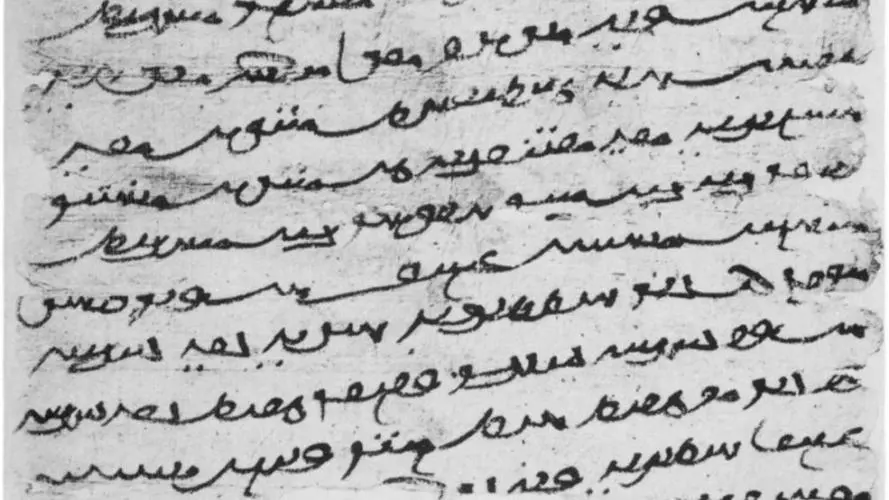
The folio bears striking offset impressions created through contact with inked surfaces on other sheets. The resulting layers of superimposed strokes give the page an appearance that, to a modern viewer, may recall postmodern calligraphic or alphabetic art. Beyond their visual effect, however, these impressions provide material evidence for the ways in which the document was handled, arranged, or stored.
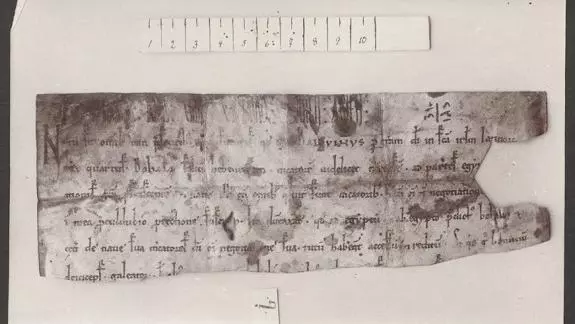
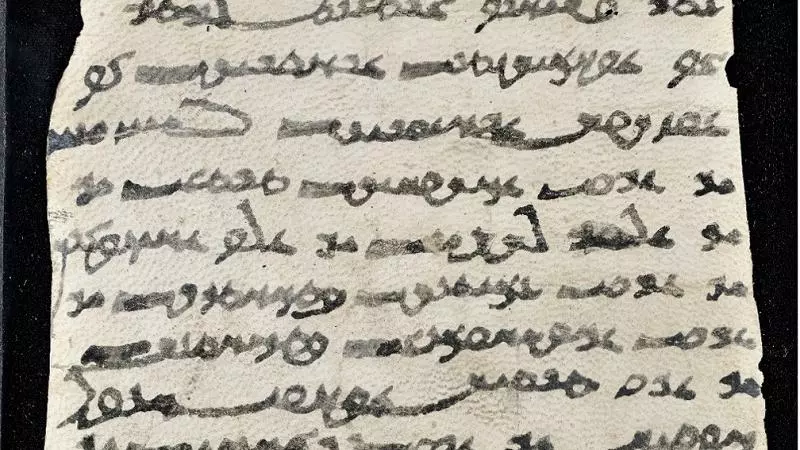
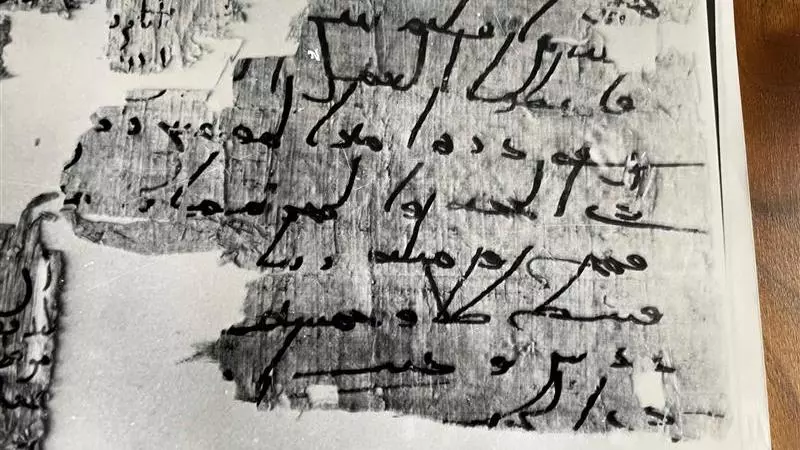
The folio has been severed in half along the vertical axis. Of particular codicological significance are the traces of binding along the margins, where threads remain attached and, in places, appear to have been interlaced. Comparable features occur in a small number of Middle Persian Pahlavi documents, including P. 55 in Basel and Berlin 24 (Weber 2008). The comparison is not exact, however, since in these documents the threads are preserved only along the upper edge, whereas Ms.Heb.8333.214 preserves traces along three of its four edges. A useful further parallel is Berk. 43A–E, a bundle of five Middle Persian documents bound together along their upper edges (Weber 2018, 127–147), suggesting that such threads could serve to join or organise related sheets. Vienna P. 404 provides another unpublished example and will be treated by the present author in a forthcoming edition within the “Pahlavi Papyri Project” at the University of Innsbruck (see Table 1).1
The precise function of the threads in Ms.Heb.8333.214 remains uncertain, but their deliberate placement suggests a codicological or administrative purpose, perhaps for binding, grouping, or archiving related material. Rather than being accidental, they may therefore reflect a broader tradition of documentary organisation extending, with local adaptations, from late antique Middle Persian administrative practice into the early Islamic Iranian world.
| Shelfmark | Documents with binding on margin |
| Ms.Heb.8333.214, recto (National Library of Israel, Jerusalem). Persian document from Bamiyan | Image

|
| P. 55 (= M I 18), recto (Basel University Library).2 Middle Persian (Pahlavi) document from Egypt | Image

|
| Wien P404, recto (Austrian National Library, Vienna).3 Unpublished Middle Persian (Pahlavi) document from Egypt | Image

|
Table 1. Similarities between two Pahlavi (Middle Persian) documents (ca. 619–629 CE) and Early New Persian medieval document from Bamiyan. Comparable binding practices are attested in P. 55 and Berlin 24 (Weber 2008, pp. 812–813, pl. XXIV), although in these cases the threads occur only along the upper edge, unlike Ms.Heb.8333.214, where three edges are bound.
The use of the verbal form afrūxtan ‘to sell’ in Ms.Heb.8333.214 recto
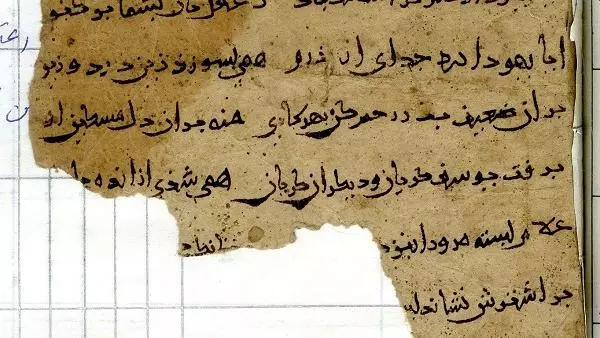
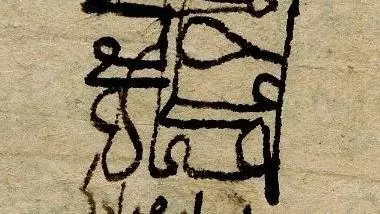
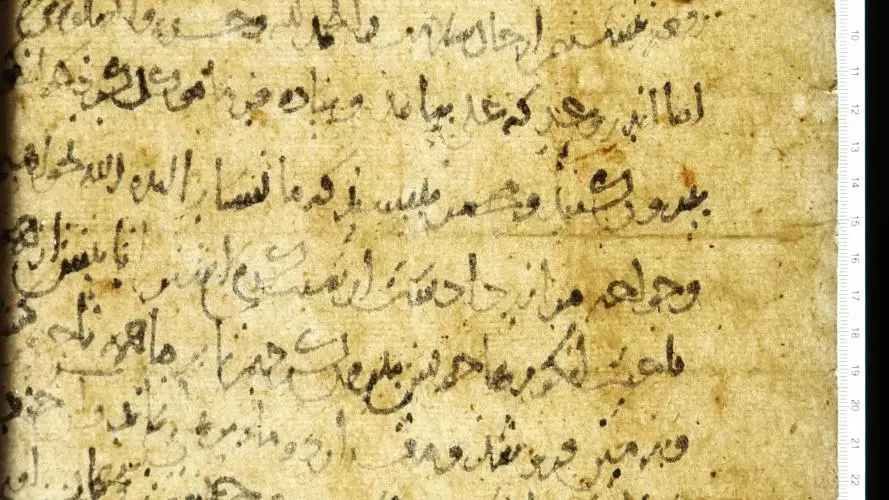
One of the most striking linguistic features of Ms.Heb.8333.214 is a past-tense third-person singular form apparently belonging to the verb ‘to sell’. Its spelling points to a form that may be normalised as afrūxt (infinitive afrūxtan). The initial vowel, graphically represented by a sign resembling aleph is unexpected (see Table 2): neither the available Middle Persian evidence nor the reconstructed Old Iranian forms of this verb contain a word-initial vowel. The spelling, therefore, raises an important question: does the aleph represent an actual feature of the spoken language, a scribal convention, or interference from another verb?
In New Persian, ‘to sell’ is represented by the present stem forūš-/furōš- and the past stem forūxt-/furōxt-, conventionally transliterated as ⟨frwš⟩ and ⟨frwxt⟩. Although the vowels following the initial consonants vary in the sources and in modern transcriptions—compare firūxtan, forūxtan, and furūxtan—the verb does not normally begin with a vowel. In Middle Persian, it is commonly written with an Arameogram in Book Pahlavi as ⟨MZBNW⟩, reads as frōš- in the present stem. The past stem is also attested in phonetic spelling as ⟨plwht⟩, without an initial aleph, and is read frōxt. The present stem is generally reconstructed as frōš-, although frōxš- has also been proposed (Mansouri 2005, 106). Historically, the verb has been traced to an Old Iranian formation consisting of the prefix fra- and a verbal adjective *wak-ta-, derived from the root √wak- ‘to speak’. On this interpretation, the regular Iranian development of the cluster -kt- to -xt- produced Middle Persian frōxt, from which New Persian forūxt-/furōxt- developed. The present stem may likewise be explained as a formation with fra-, involving the insertion of -s- into the root, the subsequent loss or weakening of k, and the development of the resulting sibilant into š. This sequence would ultimately have produced Middle Persian frōš- (Mansouri 2009, 241). Whatever the precise details of this reconstruction, it provides no historical basis for an initial vowel preceding fr-.
The spelling in Ms.Heb.8333.214 is particularly noteworthy because the resulting form, afrūxt, closely resembles a distinct Persian verb meaning ‘to kindle’, ‘to illuminate’, or ‘to cause to shine’, with the infinitive afrūxtan and present stem afrūz- (Steingass 1892, 89). The presence of aleph, thus, does more than introduce an unusual spelling: it creates a potential formal overlap between two etymologically and semantically distinct verbs. The interpretation ‘to sell’ must consequently rest not on the isolated form alone, but also on its syntactic and documentary context. Several explanations may be considered. The initial vowel could reflect phonetic prothesis—that is, the development of a vowel before the initial consonant cluster fr-. It could also represent a locally current pronunciation of the inherited prefix fra-, a graphic habit associated with the use of aleph in documentary writing, or an analogical reshaping under the influence of other vowel-initial verbal forms. A further possibility is formal contamination by afrūxtan ‘to kindle, illuminate’, although the considerable semantic distance between ‘selling’ and ‘kindling’ makes such an explanation difficult to establish without additional evidence. These possibilities need not be entirely independent: a locally pronounced prothetic vowel, for example, may have been reinforced in writing by the existence of the familiar verb afrūxtan.
At the current state of research, the evidence does not permit a definitive explanation. The initial aleph may reflect Early New Persian pronunciation or a secondary scribal, regional, or documentary development. Since it cannot be explained by the known etymology of the verb ‘to sell’, it is best regarded provisionally as a secondary Early New Persian feature, possibly resulting from phonetic prothesis, graphic convention, or analogy with afrūxtan ‘to kindle, illuminate’. Further evidence is needed to determine whether this is an isolated spelling or a broader regional or chronological tendency.
| Form | Transliteration | Meaning | |
| Line 2 | Image

| ⟨ʾfrwxt⟩ | Sell.PST.3.Sg |
| Line 2 | Image

| ⟨ʾfrwxt⟩ | Sell.PST.3.Sg |
Table 2. The attested forms of the verb ‘‘to sell’’ in the document Ms.Heb.8333.214, recto.
Analogical formation of Early New Persian as seen through the Shāhnāma and Early Judeo-Persian documents in the Bamiyan corpus
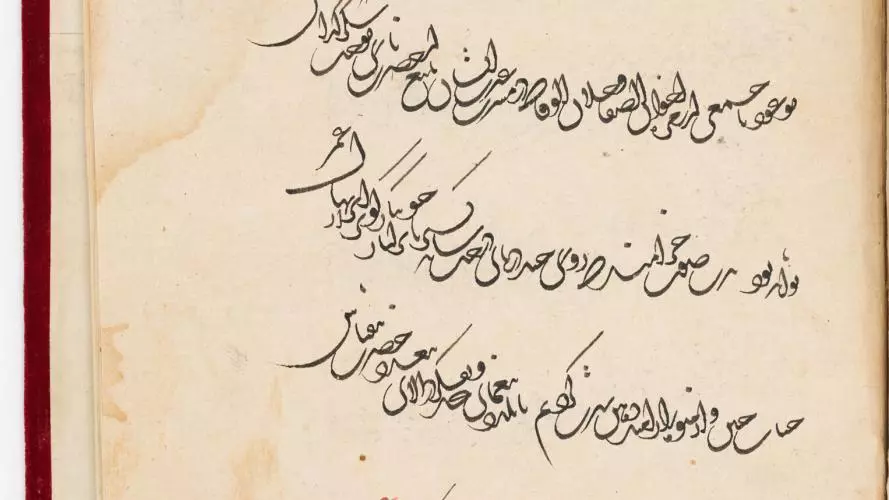
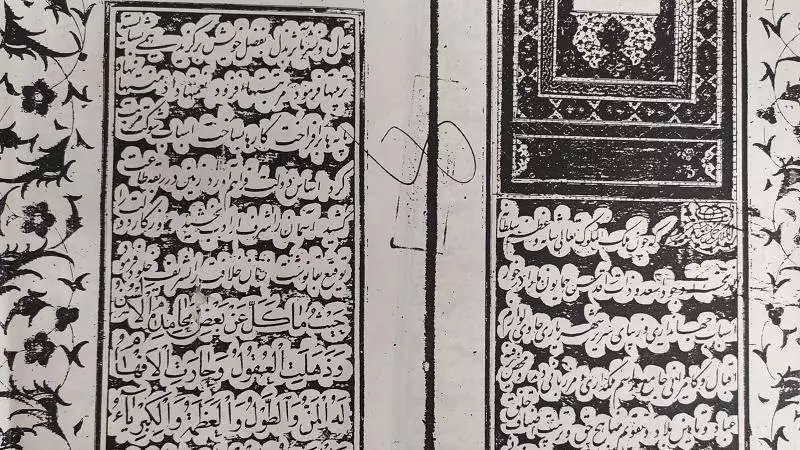
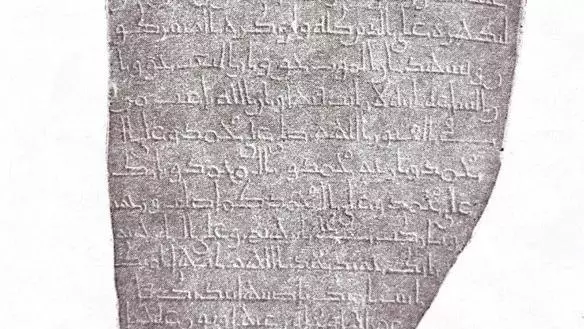
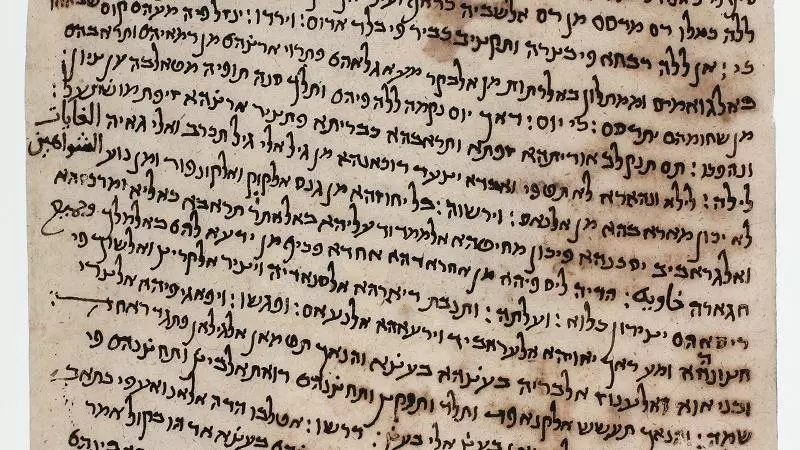
The possibility of analogical formation can be considered in relation to forms in New Persian that appear both with and without an initial vowel before initial f-. A relevant example is the name Fereydūn/ Farīdūn, which is also attested in forms with initial a-, such as Afrīdūn, which generally is known as an Arabic form of Middle Persian Frēdōn. The two spellings, ⟨frydwn⟩ and ⟨ʾfrydwn⟩, may occur within the same literary tradition, including classical Persian works such as the Shāhnāma of Firdawsī (ca. 940–1025 CE); see image 1.
It shows that the presence or absence of an initial vowel before f- could fluctuate in Persian written tradition. Admittedly, Fereydūn/Āfrīdūn is a proper noun rather than a verbal form, and for that reason it cannot by itself provide a direct morphological parallel for the verb under discussion. Nevertheless, it may still be relevant as evidence for a broader graphic or phonological tendency whereby forms beginning with f- could, in some contexts, acquire or lose an initial vowel.
Here is an example:
| Transcription | Transliteration4 | Translation |
بدو گفت شاه آفریدون تویی که ویران کنی تُنبُل جادویی | bedō goft Šāh Āfarīdūn to-yi ke vīrān konī tonbol o jādūyī | She said to him, you are King Fereydun, the one who will destroy deceit and sorcery |
فریدون چنین پاسخ آورد باز که گر با بلا چرخ را نیست راز | Farīdūn chenīn pāsox āvard bāz ke gar bā balā charx-rā nīst rāz | Fereydun answered her If Heaven is not secretly allied with calamity… |
Table 3. Two verses from Firdawsī, Shāhnāma, section 10
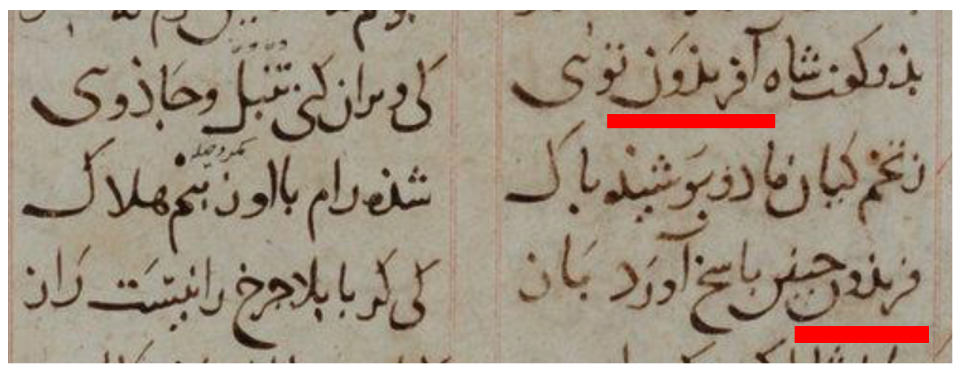
Image 1. Āfarīdūn and Fereydūn/Farīdūn in the Florence Shāhnāma, fol. 14r with red underlines, copied 614 AH (1217 CE). This is one of the earliest surviving manuscripts of the Shāhnāma. Here, ⟨ḏ⟩ is written instead of ⟨d⟩, and ⟨k⟩ is used to signify both ⟨g⟩ and ⟨k⟩. There are no diacritics (two dots) under ⟨y⟩ in many word positions; a phenomenon commonly encountered in early Persian manuscripts. Image reproduced with permission: «su concessione del Ministero della Cultura / Biblioteca Nazionale Centrale. Firenze». Further reproduction or duplication is prohibited.
Verbal examples should be preferred over parallels involving nouns or proper names. The Early New Persian verb afrūz/afrōz meaning ‘to shine’, ‘to illuminate’, or ‘to kindle’ provides a verbal parallel. Its past tense form afrūxt / afrōxt belongs to the same grammatical category as the problematic form in Ms.Heb.8333.214. This verb also displays the same broad graphic sequence—initial vowel ⟨ʾ⟩ plus ⟨f⟩, followed by the elements corresponding to ⟨r-w-x-t⟩—which also appears in the document under study. Its Middle Persian antecedents are commonly represented as abrōxt and abrōz. Historically, these forms derive from the Old Iranian root √rauk- ‘to shine, to be bright’; the same root that underlies New Persian rūz ‘day’. With the prefix abi-, the past stem was formed from an Old Iranian participial formation in -ta-. As in the development discussed above, the final consonant of the root, k, developed into x before t, producing the past-stem formation seen in Middle Persian and New Persian.
The form in the document may therefore have been influenced by analogy with verbs of the type afrūxt/afrōxt, especially if the scribe or local linguistic environment allowed some overlap between forms meaning ‘to sell’ and ‘to shine’, ‘kindle’, or ‘burn’. This possibility is significant because the two verbal formations are historically distinct: the verb ‘to sell’ belongs to the formation represented by Middle Persian frōxt and New Persian furōxt / forūxt, whereas the verb ‘to kindle, illuminate’ belongs to the formation represented by Middle Persian abrōxt and New Persian afrōxt / afrūxt. The presence of an initial vowel in the document may thus reflect either a graphic analogy, a phonological reinterpretation, or a local morphological development in which these two formally similar verbal patterns came into contact.
Although the initial aleph also occurs in other documents from Bamiyan and thus appears to be a relatively uncontroversial feature of Early New Persian, it is important to note that this development forms part of the broader linguistic transition from Middle to New Persian, particularly the restructuring of word-initial consonant clusters. One common development in New Persian is the replacement of an older initial ⟨Vf-⟩ structure by ⟨fV-⟩. More generally, words that historically contained an initial consonant cluster may exhibit parallel forms in which a vowel occurs either before or after the first consonant. This may be part of a broader development whereby initial consonant clusters were broken up in the transition from Middle to New Persian. Evidence for this is attested during earlier periods (Sadeghi 2001, 11–22). The form of the verb ‘to sell’ found in Ms.Heb.8333.214 recto fits well within this pattern, despite the etymological problems discussed above. The following verbal examples illustrate this alternation:
| Vf- form | fV- form | Category | Meaning |
| afkandan ⟨ʾfkndn⟩ | fekandan ⟨fkndn⟩ | Verb | ‘To throw’ |
| afridūn/āfaridūn ⟨ʾfrydwn⟩ | fereydūn/faridūn ⟨frydwn⟩ | Noun | ‘Personal noun’ |
| afšāndan ⟨ʾfšʾndn⟩ | fešāndan ⟨fšʾndn⟩ | Verb | ‘To scatter, sprinkle, or fall’ |
| afsāna ⟨ʾfsʾnh⟩ | fasāna ⟨fsʾnh⟩ | Noun | ‘Tale, fable’ |
| afsordan ⟨ʾfswrdn⟩ | fesordan ⟨fsrdn⟩ | Verb | ‘To freeze’ |
| afšordan ⟨ʾfšwrdn⟩ | fešordan ⟨fšwrdn⟩ | Verb | ‘To press, tie’ |
| afsūn ⟨ʾfswn⟩ | fosūn ⟨fswn⟩ | Noun | ‘Spell, deception’ |
| afzūdan ⟨ʾfzwdn⟩ | fozūdan ⟨fzwdn⟩ | Verb | ‘To add’ |
| eftālīdan ⟨ʾftʾlydn⟩ | fetālīdan ⟨ftʾlydn⟩ | Verb | ‘To distribute’ |
| oftādan ⟨ʾftʾdn⟩ | fetādan ⟨ftʾdn⟩ | Verb | ‘To fall’ |
Table 3. Selective Occurrence of ⟨Vf-⟩ and ⟨fV-⟩ Forms of the Same Words in New Persian
Taken together, these forms provide evidence that alternation between initial ⟨Vf-⟩ and ⟨fV-⟩ was not exceptional in New Persian verbal morphology. Comparable variation is also found in personal names, as noted above. The alternation may involve either the loss of an initial ⟨ʾ⟩, representing a vowel, or the secondary addition of such a vowel before the initial ⟨f-⟩.
Conclusion
The examples discussed in this article provide evidence to argue that the verbal form attested in Ms.Heb.8333.214 recto is analogical. This evidence suggests that the form belongs to a linguistic environment in which Early New Persian verbal morphology was still being shaped through processes of analysis and re-analysis. Speakers and scribes could analogically draw on familiar verbal patterns in which forms with an initial vowel plus f- (⟨Vf-⟩) alternated with forms beginning directly with f- (⟨fV-⟩). The unusual form of the verb ‘to sell’ in the document may therefore reflect an analogical extension based on these broader New Persian patterns. On this interpretation, the document preserves an otherwise unattested, or at least highly unusual, formation created under the influence of other Persian words exhibiting precisely this alternation between initial ⟨Vf-⟩ and ⟨fV-⟩. This linguistic formation occurs at the emergence of official use of Early New Persian when Middle Persian initial consonant clusters were disappearing and being transformed into initial VC or CV sequences which may have inspired an analogical verbal formation. The document from the Bamiyan corpus discussed in this article may thus reflect a period when Middle Persian was being replaced in official use by Arabic and Early New Persian, before the latter had developed standardised bureaucratic conventions.
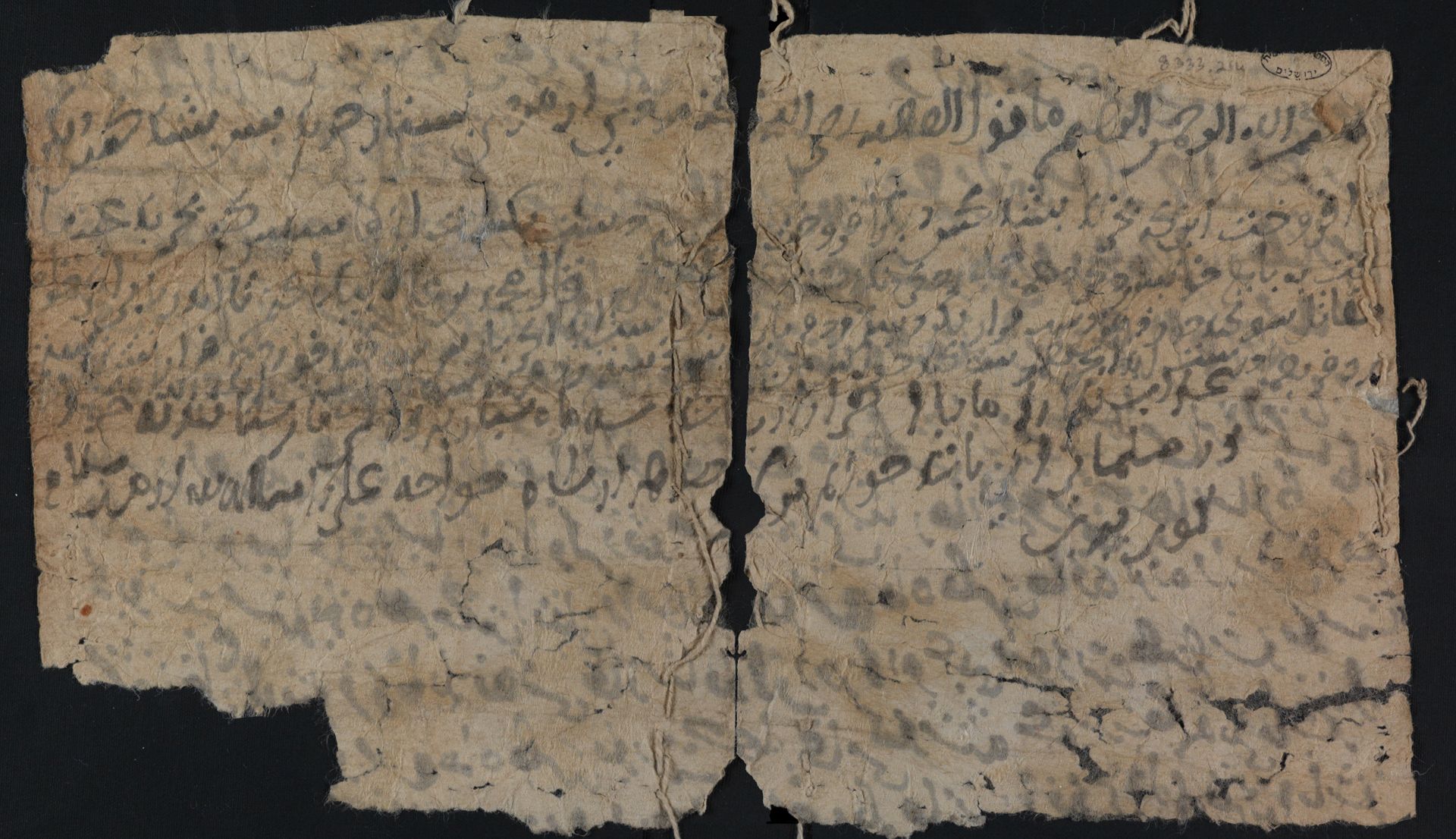
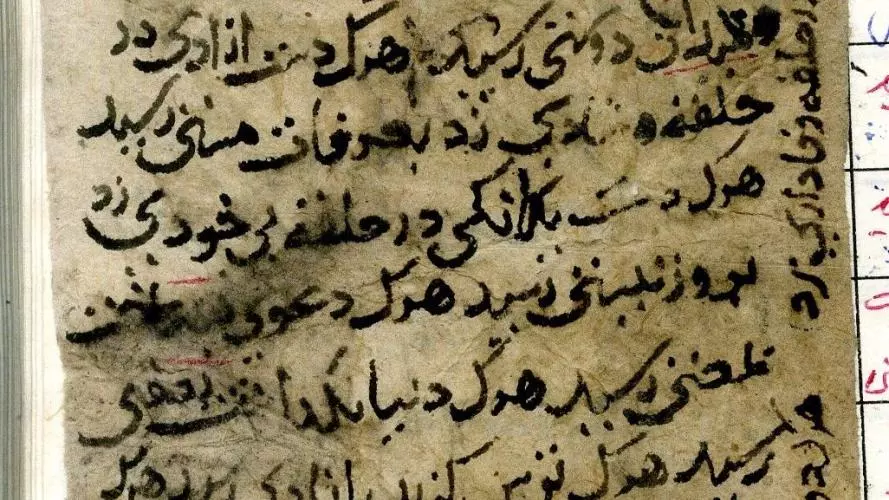
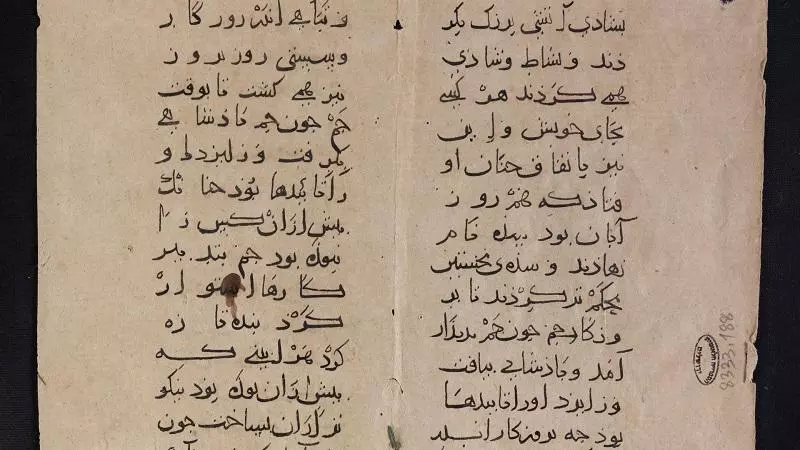
Image 2. NLI, Ms.Heb.8333.214 recto. Reproduced with the permission of the National Library of Israel. "Ktiv" Project. Full details of the document can be found in the Invisible East Digital Corpus.
Transcription
National Library of Israel, Ms.Heb.8333.214 recto. O. Haim, P. Firoozbakhsh, A. Azad, N. Saqee and M. Arghandehpour, unpublished transcription and translation available online through the Invisible East programme.
بسم الله الرحمن الرحیم ما قول الفقیه رضی الله {} عنه مردی از مردی بستان خرید پس بشد کس دیگر
افروخت این که بخرید بشد کس دیگر افروخت {-/+1} سه دست بگشت این [-/+ 1] سپس که (؟) بخرید [+/- 1]
[ر]فت (؟) به بایع خویش رد(؟) کرد همه جمله رد کردند [+/- 2] {-/+1} قال محمد بن علی [-/+ 1] پیدا (؟) کنم تا اندر بابی این قول
مقاتل سوگند خورذ [که] دست فراز نکردستم مردمی (؟) فاز (؟) {-/+1} نبودست (؟) اید اگر بپارسی سوگند خوردی (؟) فراز نشذستم (؟)
[-/+ 1] فر همه (؟) درست اید اگر همه (؟) سوگند خورد که (؟) من {-/+1} نبوذستم رد (؟) [+/- 5]
عذاب ندارذ ما باو فراز ار(؟) [-/+ 1] بـ{-/+1}شد سه ماه بستان برذهای (؟) فاز ستانند به خوذ
در مسلماني این باشذ جوانمرد[ی] {} صذ هزار سلام خواجه علی ایده الله (؟) از من سلام
گوي بوي
Translation
- In the name of God, the Merciful, the Compassionate. What is the judgement of the faqīh, may God be pleased {} with him. A man bought a garden from [another] man. Then
- he sold it to someone else. The one who bought it [last,] sold it to [yet] another person. {This garden} changed hands three times. This [man?] who then bought it [+/- 1]
- went to the seller [+/-2] everyone refused. [+/- 2] {-/+1} The judgement of Muḥammad b. ʿAlī [+/- 1] was: Let me refer to
- this statement by Muqātil on this subject (?): “He swore, ‘I did not raise my hand. [+/- 5 {}] When one swears an oath in Persian one doesn’t need to stand up for it. (?)
- [+/-2] It is correct that everyone swears an oath that, “It was not me.” [+/- 6 {}]
- He does not have a case. [Tell him: ?] “You have held the garden for three months. You shall return it.
- This is chivalry in Islam.” {} One hundred thousand greetings to Khwāja ʿAlī, may God help him. Send my regards
- to him.
Abbreviations
3: 3rd Person
C: consonant
MP: Middle Persian
PST: Past tense
SG: singular
V: vowel
{ }: denotes where the folio has been severed in half
Notes
- https://www.uibk.ac.at/de/alte-geschichte-orient/forschung/projekte/pah…
- Image is Reproduced with permission of the Universitätsbibliothek Basel.
- I am indebted to Dr Alexander Nikitin in St Petersburg for the digital image.
- The transcription follows Standard Persian of Iran. It should be noted, however, that the text is historical, and that its actual pronunciation in Classical Persian may have differed, especially regarding vowels.
Mansouri, Yadollah. 2005. Barrasī-yi rīsha-shināxtī-yi feʿlhā-yi zabān-i Pahlavī (fārsī-yi miyāna-yi Zardushtī) [An Etymological Study of Pahlavi Verbs]. Edited by Changiz Molaei. Tehran: Academy of Persian Language and Literature.
Mansouri, Yadollah. 2015–2022. Pahlavi Dictionary [Pahlavi–Persian–English]. 5 vols. Tehran: Shahid Beheshti University Press.
Mansouri, Yadollah, and Jamileh Hassanzadeh. 2009. Barrasī-yi rīshe-shināxtī-yi afʿāl dar zabān-i fārsī [An Etymological Study of Persian Verbs]. Supervised by Bahman Sarkarati. Tehran: Academy of Persian Language and Literature.
Sadeghi, Ali-Ashraf. 2001. Masāʾil-i tārīxī-yi zabān-i fārsī [Historical Issues of the Persian Language]. Tehran: Sokhan.
Schmidt, Stefanie. 2020. “Pahlavi Texts: 69. List of Personnel; 70. Drawing.” In Papyri of the University Library of Basel (P.Bas. II), edited by Sabine R. Huebner, W. Graham Claytor, Isabelle Marthot-Santaniello, and Matthias Müller, 315–320. Archiv für Papyrusforschung, Beiheft 41. Berlin and Boston: De Gruyter. https://doi.org/10.1515/9783110680973.
Steingass, Francis Joseph. 1892. A Comprehensive Persian-English Dictionary, Including the Arabic Words and Phrases to Be Met with in Persian Literature. London: Routledge & K. Paul.
Weber, Dieter. 1992. Ostraca, Papyri und Pergamente: Textband. Corpus Inscriptionum Iranicarum, Part III: Pahlavi Inscriptions, vols. IV–V: Ostraca and Papyri, Texts I. London: School of Oriental and African Studies for the Corpus Inscriptionum Iranicarum.
Weber, Dieter. 2008. Berliner Pahlavi-Dokumente: Zeugnisse spätsassanidischer Brief- und Rechtskultur aus frühislamischer Zeit. With contributions by Myriam Krutzsch and Maria Macuch. Iranica 15. Wiesbaden: Harrassowitz Verlag.
Weber, Dieter. 2018. “Pahlavi Documents of Windādburzmihrābād, the Estate of a Zoroastrian Entrepreneur in Early Islamic Times (With an Excursus on the Origin of the Fulanabad-Type of Village Names).” In: BAI, New Series, vol. 28, pp. 127-147.
Manuscripts:
Shāhnāma Manuscript dated 614 AH. Florence, Biblioteca Nazionale Centrale di Firenze, MS Magl. Cl. III.24, fol. 14r. Digital facsimile (accessed August 12, 2026).
Cite this article
Abedi, M. 2026. "Analogy in Motion: Language Change as seen in a Persian Document from Bamiyan" Document of the Month. Invisible East. doi:
About the author
Milad Abedi is a postdoctoral researcher at the University of Innsbruck, specialising in Old and Middle Iranian languages, Iranian loanwords, language contact, and Book Pahlavi. He completed his doctoral studies in linguistics in Zurich, Paris, and Vienna, after earning an MA in Ancient Languages of Iran. He previously worked on the SNSF-funded Sino-Indo-Iranica Rediviva project at the University of Zurich. He currently serves as primary reader for The Pahlavi Papyri of the Austrian National Library, led by Robert Rollinger and supported by the Porkar Privatstiftung, the UCI Jordan Center for Persian Studies and Culture, and the FWF Cluster EurAsian Transformations.
Acknowledgements:
I would like to thank Aleksander Engeskaug for his careful review and thoughtful suggestions, and Professor Arezou Azad and Dr. Mateen Arghandehpour for their helpful comments and support.
The online series, Document of the Month, presents some of the most interesting and revealing medieval documents from the desks of Invisible East researchers and their colleagues worldwide. Each piece in the series is dedicated to a single document or a closely related group of documents from the Islamicate East and tells their story in an engaging and accessible way. You will also find images, editions and translations of the documents. If you would like to contribute to the Document of the Month series, please, get in touch with the team.